Showing posts with label Dyan Cannon. Show all posts

Sunday, 6 March 2022

Movie Review: The Love Machine (1971)

A drama set in the world of television executives, The Love Machine is an emotionally hollow crawl towards trashy fun.

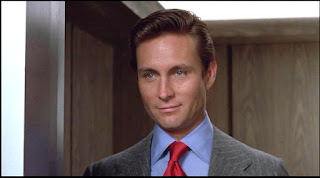
In New York City, Robin Stone (John Phillip Law) is the young and handsome local news anchor at the IBC television network owned by Greg Austin (Robert Ryan). Stone starts a romance with fashion model Amanda (Jodi Wexler), but he is not interested in the long-term commitment she eagerly seeks. Stone is also good friends with openly gay fashion photographer Jerry Nelson (David Hemmings), but rebuffs his advances for a relationship.

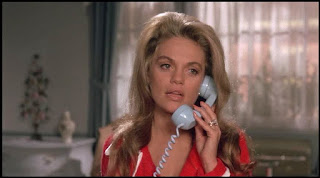
Greg's wife Judith (Dyan Cannon) spots Stone's potential as a woman magnet and therefore a ratings booster. Greg responds by rapidly promoting Stone, causing friction with seasoned executive Danton Miller (Jackie Cooper). Judith starts an affair with Stone and seeks to become his permanent lover. When Greg suffers a health crisis, Stone's career appears unstoppable, but happiness will prove elusive.

An adaptation of the Jacqueline Susann best-seller, The Love Machine carries the whiff of glossy ambitions hampered by budget constraints. In the hands of director Jack Haley Jr. and writer Samuel A. Taylor, the exotic sex-saturated world of network television power brokers and fashion models is reduced to the level of, well, a cheap television show. Despite two Dionne Warwick original songs (one bad, the other worse), the available talent is nowhere near good enough to convey the intended cut-throat connivance and jet-set glamour.
A big part of the problem is the central character of Robin Stone, who remains a stiff emotional vacuum sucking energy out of the screen. John Phillip Law was a late replacement in the role and never settles, and the script does not help by providing no context for Stone's cold-blooded lust for power and narcissism. And yet every woman in the movie falls in love with him at first sight, and in a questionable interpretation of feminism, both Amanda and Judith (and other peripheral women) are sexually liberated but rush to define their self-worth by craving a man's immediate commitment.

Meanwhile, the storytelling shortcomings are further exposed in a barely relevant but time consuming sub-plot. Stone's rival Danton Miller finds a surprise hit in a low-brow show featuring comedian Christie Lane (Shecky Greene). He is catapulted from second-rate lounge act to national stardom, and rapidly falls in eternal love with the model Amanda. Having fulfilled the role of obstructive non-entity, Christie summarily drops out of the movie.

Entertaining snippets lurk within the various cluttered corners. In fashion photographer Jerry Nelson, The Love Machine features a well-rounded and prominent gay character. The visuals obsess over close-to-bizarre representations of leading-edge fashions, the women valiantly trying to pull off looks normally reserved for the runway. A bedroom is set on fire while a threesome heats up in the shower.

The tone finally flirts with unintended slapstick by somehow contriving a wacky four-way fight between two gays, one heterosexual, and one woman. Then the drama ends without ending, a suitable send-off for an exercise in blunderous ogling.


All Ace Black Movie Blog reviews are here.

Friday, 8 May 2020

The Movies Of Dyan Cannon


All movies starring Dyan Cannon and reviewed on the Ace Black Movie Blog are linked below:


All Ace Black Movie Blog reviews are here.
The Movie Star Index is here.

Sunday, 23 December 2018

Movie Review: The Last Of Sheila (1973)


A mystery thriller, The Last Of Sheila is clumsily mounted and poorly executed.

In Hollywood, gossip columnist Sheila is killed in an unsolved hit-and-run. A year later, her film producer husband Clinton (James Coburn) invites six members of the film world, all potential suspects in Sheila's death, to spend a week on his yacht in the Mediterranean.

The invitees are fading film director Philip (James Mason), starlet Alice (Raquel Welch) and her husband/manger Anthony (Ian McShane), talent agent Christine (Dyan Cannon), struggling writer Tom (Richard Benjamin) and his wife Lee (Joan Hackett).

Clinton introduces them to a mystery game they will play during the week, with each assigned a secret card denoting a transgression, with one to be revealed every night through a treasure hunt style contest at successive ports of call. Mishaps start to beset the yacht, and suspicions emerge that Clinton may have a sinister motive related to Sheila's death.

Directed by Herbert Ross, The Last Of Sheila is co-written by actor Anthony Perkins and musician Stephen Sondheim. The lack of writing discipline is evident in a muddled premise, lack of character development, a midway jarring change in tone, and a tired, highly illogical resolution featuring dozens of late-arriving factoids introduced in inept flashbacks. This was a troubled production beset by on-set tensions betrayed by distracted and incohesive cast performances.

The mystery, once revealed, is far beyond plausible, The Last Of Sheila falling into a trap of trying to justify a murder solely for the pleasure of the script. Along the way, the first half of the film rushes towards an ill-defined game, but only plays two out of six find-the-sinner rounds before abandoning the concept altogether in favour of a stage-bound Agatha Christie whodunnit, absent a clever detective.

The morsels of enjoyment are few and far between, and include Mason digging deep to try and salvage the outcome late in the proceedings, with the grounded Joan Hackett the only other cast member appearing to care. A clever clue appears early in the film and offers a late blip of a pulse upon re-emerging towards the otherwise limp finale.

The Last Of Sheila carries some potential, but is fumbled into the murky Mediterranean waters.


All Ace Black Blog Movie Reviews are here.


Saturday, 22 December 2018

Movie Review: Deathtrap (1982)


A mystery thriller, Deathtrap is firmly stagebound but still offers enough cerebral tricks and turns to pique interest.

Sidney Bruhl (Michael Caine) is a famous Broadway playwright known for his clever murder mysteries, but he is losing his touch and suffering through a series of flops. At his impressive converted windmill home in the Hamptons, where one wall is adorned with antique weaponry souvenirs from his plays, he is consoled by his highly-strung wife Myra (Dyan Cannon), who suffers from anxiety but is independently wealthy.

Sidney receives an exceptionally promising draft script for a play called Deathtrap written by Clifford Anderson (Christopher Reeve), who previously attended one of Bruhl's writing seminars. Sidney starts musing about inviting Clifford over, killing him and claiming the script as his own, horrifying Myra. Clifford does show up, hoping to get writing tips and advice to improve the script, and Myra gets increasingly frantic, not sure if her husband will go through with his devious plan.

That's as far as should be revealed about the plot, which then goes on a mazy run of surprises with varying levels of quality and success. An adaptation of Ira Levin's hit play, Deathtrap is directed by Sidney Lumet and written for the screen by Jay Presson Allen. The source material is perfect for a stage setting, inspired by intimate Agatha Christie murder mysteries and twisty thrillers like Sleuth. Lumet respects the film's origins, and mostly concentrates on capturing the play on film, with good work from the three cast members to enhance key close-ups.

The first half is by far the stronger part of the film. Lumet expertly establishes Sidney's character and the relationship with Myra, setting the stage for many possibilities to come, and the foul play opportunities are only enhanced when the cocky Clifford shows up. Despite many added convolutions the second half wilts, with next-door neighbour and psychic Helga Ten Dorp (Irene Worth) an unfortunate mismatch within the story's structure, and the film never regains a firm footing.

The performances are not unexpectedly theatrical, with slightly exaggerated mannerisms and louder than necessary dialogue delivery. Sufficient quality resides in the cast to pick up raised eyebrows, conspiratorial minds, and devious plots-in-the-making. Ten years after participating in the similar shenanigans of Sleuth, Caine provides the solemn desperation of a once-celebrated man now being discarded as a has-been by the chattering class. Reeve contributes freewheeling relative youth, and Cannon adds some on-point humour with a shriek-filled performance.

Deathtrap may not be exceptionally clever, but it is sufficiently amusing.


All Ace Black Movie Blog reviews are here.

Saturday, 1 December 2018

Movie Review: Author! Author! (1982)


A mild drama, comedy and romance, Author! Author! delves into one man's work and family issues but finds little of interest.

In New York City, Ivan Travalian (Al Pacino) is a respected playwright and loving father of five kids, preparing for the upcoming Broadway debut of his new show. With his producer fretting about costs and a second act that does not work, Ivan has to fire the director and find a new leading lady. On the home front, Ivan's life falls apart when his wife Gloria (Tuesday Weld) admits to having an affair and departs, leaving Ivan in charge of four of her kids from previous marriages plus one boy of his own.

Ivan convinces glamorous movie star Alice Detroit (Dyan Cannon) to join the play, and they are soon romantically involved. She moves in with him but does not enjoy his life of domesticity. Gloria's kids are shuttled off to their respective fathers, but more unexpected complications are lurking to further strain Ivan's personal life.

Written by Israel Horovitz and directed by Arthur Hiller, Author! Author! is a mundane nonentity that awkwardly sniffs around a couple of topics and departs with no impact. While Ivan's life contains nuggets of potential interest, Horovitz genuinely seems to have nothing to say, and neither the putting-on-a-play nor the family-in-turmoil parts of the story appear to head in any specific direction.

Ivan is a loving father doing his best in a modern family full of kids assembled from previous and current marriages. But as a sorry indication of the film's shiftless non-presence this part of Ivan's life somehow ends up on a rooftop with back and forth hollering to the street below featuring incompetent cops and one of the kids' other fathers.

Back at rehearsals, Ivan cannot get the second act of his play to work, and after plenty of toil Horovitz and Hiller decide to just abandon that particular subplot in favour of stock sentimentality.  Meanwhile, the two women are provided with no context other than their interactions with Ivan, Gloria and Alice barely defined beyond plastic plot devices.

The film may have worked better as an intriguing character study with a better central performance, but Al Pacino cruises with a singularly lackadaisical attitude, never shifting away from harried-but-still-cool guy.

Author! Author! ends with the manufactured excitement of a Broadway opening night, but the film barely deserves to make it past the first draft.


All Ace Black Blog Movie Reviews are here.


Wednesday, 20 March 2013

Movie Review: The Anderson Tapes (1971)


More weird than good, The Anderson Tapes mixes under-cooked caper with poorly defined conspiracy and yet the result is oddly pleasing.

Safe cracker John "Duke" Anderson (Sean Connery) is released from prison and immediately makes his way to New York City and into the arms of Ingrid (Dyan Cannon), his former mistress. She now lives in a swanky apartment building, and the gears in Duke's head start to turn: all the units in the relatively quiet building look rich and relatively easy to break into. Oblivious to the watchful lenses of a multitude of surveillance cameras belonging to various government and private agencies scattered throughout the city, Anderson starts assembling a team.

The Kid (Christopher Walken) is an electronics expert who was in prison with Duke; Tommy Haskins (Martin Balsam) is an antique dealer who can help identify and then sell the valuable items in each apartment; and Jimmy (Paul Benjamin) is the driver. Finally, the tottering "Pop" (Stan Gottlieb) will impersonate the doorman to keep watch in the lobby. The plan will be financed by mobster Pat Angelo (Alan King), but he insists on an unexpected twist that causes disarray: tough guy "Socks" Parelli (Val Avery) has to be part of the team.

The Anderson Tapes introduces an undercurrent of unease due to all-pervasive surveillance running amok in modern society, and as Anderson and his crew plan the robbery, their every move is surreptitiously tracked by various unnamed government agencies using audio and film recordings. None of the G-men appear to be talking to each other and the Frank Pierson script makes the point that capturing volumes of information and putting it to good use are two different things. None of the dots are connected, the robbery plan isn't disrupted, and the in-progress police response is triggered by a paraplegic boy using a ham radio connected through Hawaii. 

The central robbery as conceived by Duke Anderson is such a sure-fire disaster that some moments start to unintentionally descend to Pink Panther farcical territory. The robbery unfolds at a pace slow enough to make the tortoise look good, and the bungling burglars wear masks yet call each other by name in front of witnesses while shuttling up and down the building bundled into a slow moving elevator. With half of the New York police force assembled in the street waiting for Anderson and his crew to conclude their plodding work, the robbery becomes a predictably calamitous train-wreck unfolding in slow motion.

With Quincy Jones providing a jazzy music score, director Sidney Lumet makes good use of the acting talent at his disposal. Sean Connery puts in a good shift trying to distance himself from the Bond persona, and notably makes no attempt to hide the thinning hair. Anderson is a jailed criminal when the movie opens and confirms himself as a failed criminal, his unsophisticated methods as far as imaginable from suave assuredness.

In support, Dyan Cannon provides Anderson with a professionally opportunistic bed partner, Christopher Walken makes his studio film debut as the mop-haired electronics expert (and, in a further example of a bad plan going awry, somehow becomes a safe-cracker during the course of the robbery), and Martin Balsam plays the gay antique trader with a barely concealed smile. But the real over-the-top performances come from Val Avery as the always-about-to-boil-over henchman Socks and Ralph Meeker arriving late as puff-chested police Captain Delaney.

By the time Meeker starts issuing bizarre orders to his men and Avery starts punching victims up and down the building in a perfect example of how to cause an unnecessary ruckus at the worst of times, The Anderson Tapes concludes that criminals can and will find ways to shoot themselves in the foot, regardless how many cameras and microphones are recording their every dense move.


All Ace Black Movie Blog reviews are here.

Wednesday, 6 March 2013

Movie Review: Shamus (1973)


A private detective adventure set in New York, Shamus partially achieves the amiable tone of one bullheaded man in way over his head amongst a scuzzy sea of criminality. But the murder and weapons smuggling plot cascades too quickly into baffling territory, dulling the potential for the movie to shine.

Shamus McCoy (Burt Reynolds), a last-resort private detective, is unexpectedly retained by wealthy diamond magnate E. J. Hume (Ron Weyand) to investigate the brutal murder-by-incineration of a jewel thief. McCoy follows a trail of dangerous scum that leads to retired football star Felix Montaigne (Alex Wilson), who is now running a shady trading company.

Felix lives with his sister Alexis (Dyan Cannon) in a glitzy Manhattan apartment, and while Felix is evasive in answering McCoy's questions, Alexis soon becomes a willing bed partner for the dogged detective. McCoy uncovers an illegal, large-scale weapons smuggling operation being run by Felix and a silent partner, and his investigations prompt a spate of new violence as tough guys move in to silence the detective.

The Barry Beckerman script, based on Ed McBain's "87th Precinct" series of novels, contains a couple of welcome nods to The Big Sleep. McCoy's initial meeting with E. J. Hume turns Philip Marlow's meeting with General Sternwood on its head, Hume keeping his office ice cold while Sternwood lived in a humid swamp. And just like Marlowe, McCoy kills time on a stakeout by seducing, in record time, a busty bookstore clerk.

Director Buzz Kulik gives Shamus an attractive look, stylishly capturing a dynamic New York in all its 1970s earthiness. The action scenes are animated without being jarring, the movie mixing some bone crunching brutality with enough character interaction to bring Shamus' world to life.

Kulik and Beckerman also score points for presenting a terrific contrast between McCoy's austere, barely functional  apartment, and the rich, elegantly furnished pad of Felix Montaigne, the latter representing the latest in 1970s high-end chic.

Reynolds is fine as a gruff detective curious enough to pursue a case much larger than his abilities, but keenly aware that he is more than likely being gamed. McCoy is surrounded by memorable secondary characters representing friends and family, and more than the usual amount of time is invested in humanizing his surroundings. The relationship with Dyan Cannon's Alexis is less than plausible and appears thrown into the script simply to provide relief from the raging manliness.

But Shamus does creak, and eventually the edges fall off, in a plot that spirals into incomprehensible territory all too soon. None of the key criminal relationships or motivations are ever explained. The link between the original murder and the weapons smuggling operation is never revealed, nor is E. J. Hume's shady role in all the wrong-doings clarified. And there simply isn't enough intrigue, mystery or slime built around the malevolent characters to cover the large gaps in logic. Shamus is left flailing against all-comers, unable to tame a conspiracy against common sense, but looking good while trying.


All Ace Black Blog Movie Reviews are here.