Showing posts with label Susannah York. Show all posts

Saturday, 15 January 2022

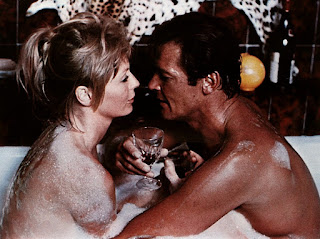
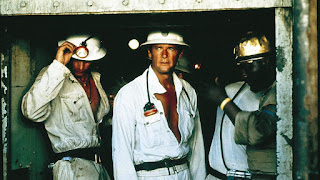
Movie Review: Gold (1974)

A thriller set in the high-stakes mining industry, Gold is ambitious but uneven. 

The setting is South Africa, where an explosion at the Sonderditch gold mine results in multiple fatalities despite the best rescue efforts of underground manager Rod Slater (Roger Moore). The explosion was caused during an unsanctioned dig towards an underground dike ordered by the mine's director Manfred Steyner (Bradford Dillman), who is married to Terry (Susannah York), the granddaughter of the mine's owner Hurry Hirschfeld (Ray Milland).

Manfred is part of an evil international syndicate led by London-based gold investor Farrell (John Gielgud). By breaching the dike and flooding Sonderditch and adjacent mines, the syndicate aims to profit on the markets. The unsuspecting Slater is promoted to general manager, and also starts an affair with Terry. Manfred orders Slater and his crews to dig towards the dike, and potential disaster. 

With Roger Moore enjoying international fame after his first 007 outing, producer Michael Klinger assembles a Bond-like crew featuring director Peter Hunt, editor John Glen, production designer Syd Cain, and titles designer Maurice Binder. Gold is a not-bad adaptation of a Wilbur Smith book, the Stanley Price script not lacking in scope, characters, locations, and effort.

The film starts and ends strongly. The opening is literally a bang, the dangerous world of mining introduced through an explosion and breathless rescue operation. The climax is a similarly thrilling race to avert a complete catastrophe. In between, the narrative chugs along but the pace slows as the conspiracy unfolds and plenty of screen time is occupied by a rather tepid romance between Slater and Terry.

Mostly filmed in apartheid-era South Africa, Gold features plenty of travelogue material and sometimes cringey attempts to avoid the obvious. Only one character is overtly racist, and Black culture is represented through tribal dances and soccer matches. Black miner King (Simon Sabela) has a prominent and heroic role, but it's a whites-only affair at the cocktail parties and serious meetings.

John Gielgud's ruthless market manipulator and Bradford Dillman's slimy germophobe combine for a potent duo of antagonists lined up against Moore's unbuttoned-shirt heroics. The production values are adequate, and the film enjoys a reasonable layer of gloss. Gold may not bedazzle, but neither is it dull.


All Ace Black Movie Blog reviews are here.

Monday, 13 September 2021

Movie Review: The Silent Partner (1978)

A suspense thriller with dollops of hardened violence, The Silent Partner is a clever and twisty story with two very different thieves engaging in an unforgiving duel.

In Toronto, bachelor Miles Cullen (Elliot Gould) is a senior cashier at a bank located within a large mall. A collector of exotic fish, Miles is quiet and appears boring, but he is also observant. His married boss Packard (Michael Kirby) is having an affair with floor manager Julie (Susannah York), who is interested in Miles but can't quite figure him out. 

With Christmas approaching, Miles outsmarts Santa Clause-disguised bank robber Harry Reikle (Christopher Plummer), who gets away with little money while Miles pockets the best part of $50,000 without anyone noticing. As a bonus, Miles also becomes a media celebrity for his heroics in thwarting the crime.

Miles hides the stolen money in a safe deposit box, but Reikle is a vicious criminal who will stop at nothing to recover what he perceives as his take. He starts intimidating Miles, triggering a dangerous battle of wits between the two men. Meanwhile Miles' romantic prospects brighten when sprightly nurse Elaine (Celine Lomez) enters his life.

A Canadian production, The Silent Partner adapts the novel by Danish writer Anders Bodelsen with unrepentant deviousness. The Curtis Hanson script succeeds in creating a protagonist out of an almost accidental thief, and director Daryl Duke delivers a Hitchcockian chess match between two men simply unwilling to yield, all played against an Oscar Peterson music score with a wicked undercurrent of humour and malevolence holding hands.

Miles is easy to underestimate, a trait he uses to his advantage. His theft is surprisingly simple, trading on honest demeanour to pin the entire blame on Reikle. But a man willing to dress up as Santa Clause to rob a bank will not just accept his humiliation. In one of his scariest screen roles, Christopher Plummer creates a ruthless villain. His early assault on a sex partner appears vicious, but fades into insignificance when Reikle later reveals the true depths of his barbarism, providing The Silent Partner with a memorable and shocking jagged edge.

Accompanying the criminality are two romantic stories to provide a breather from impropriety. Julie knows she is wasting her time having an affair with the sleazy Packard. But unaware of what Miles is up to, she cannot get him to focus. Enter Elaine, who is quickly more successful worming her way into Miles' heart and bed and helping him with an awkward predicament, while carrying secrets of her own. 

The Silent Partner teases with the premise that crime maybe could pay when the victim is a criminal, and demonstrates with delightfully perilous convolutions.


All Ace Black Movie Blog reviews are here.

Thursday, 2 June 2016

Movie Review: They Shoot Horses, Don't They? (1969)


A depression-era drama, They Shoot Horses, Don't They? is a grim descent into the psyche of despair. The story of desperate couples competing in an inhumane dance marathon is both brilliantly captivating and utterly exhausting to watch.

It's 1932, the Great Depression has destroyed the economy, and in California hundreds of economically deprived couples converge at the La Monica ballroom overlooking the Pacific Ocean to compete in a dance marathon. With a prize of $1,500 at stake for the last couple standing, the dancers have to stay continuously on the move on the dance floor, and are allowed 10 minute breaks every 2 hours and 7 meals a day. The host is Rocky (Gig Young), who runs the contest as an entertainment spectacle for a paying audience. Some of the contestants are in the competition just for the food, while the spectators sometimes throw pennies at the dance floor as encouragement, and the loose change is eagerly scooped up by the pathetic dancers.

The entrants include the tough Gloria (Jane Fonda), who teams up with Robert (Michael Sarrazin) when her original partner is not allowed to register due to a persistent cough. Other participants include grizzled former navy man Harry (Red Buttons) and his partner Shirley (Allyn Ann McLerie); aspiring actress Alice (Susannah York) and her partner Joel (Robert Fields); and veteran dance marathon contestants James (Bruce Dern) and his pregnant wife Ruby (Bonnie Bedelia).

Her unforgiving life to date means that Gloria brings a caustic, negative attitude to the dance floor. She refuses to respond to Robert's attempts to get to know her, and manages to antagonize James by continuously questioning Ruby about the wisdom of bringing a baby into a life of poverty. The hours turn to days and then weeks, the test of endurance drags on under Rocky's watchful business-focused eyes, and Gloria will have to survive more than one setback to stay among the competitors.

Directed by Sidney Pollack, They Shoot Horses, Don't They? is an almost hallucinatory experience. This is a lyrical exploration of tragic souls chasing dreams of wealth, and as staggering fatigue sets in Pollack is unrelenting in his focus on the dance floor, where bodies barely able to stand emit an overwhelming sense of sorrow. Remarkably the film maintains and builds interest over two hours, as gradually basic concepts such as winning and losing fade into the background and the theme of emotional durability in the face of the marathon's barbarity comes to the fore.

Entirely set within the mostly windowless confines of the La Monica ballroom, the cameras stay with the contestants as they push themselves through the endless marathon, a test of mental sanity as much as physical endurance. Before long Robert is struggling in vain to catch a glimpse of the outside world, as night and day meld into each other, the bands play on and the dancers shuffle their feet unenthusiastically.

The drama comes from watching the couples subject themselves to the humiliation of the competition out of sheer despondency. The marathon is not about hours or days, but weeks and then months, and the misery of the competition is compounded by the wretched realization that the dancers have no life outside the dance hall. No children, no jobs, no loved one who care about them, no hobbies, no purpose and therefore no hope. Rarely has the human wreckage of an economic depression been laid so bare.

Gloria emerges as physically and mentally strong, but also the catalyst for most of the trouble that happens between the dance sessions. She starts the marathon already at the end of her rope, quite fed up with her raw deal out of life, and unwilling to shut-up about it. She approaches her opponents and Rocky as compounding everything bad in her world, and it does not take her long to establish herself as the most derided contestant on the dance floor. She endures, turning every situation to her advantage, but Rocky knows that every contestant has a breaking point, and it is his job to find it. Fonda brings Gloria to life with a powerful, defiant performance.

The other characters create a rich tapestry of desperate yet determined contestants to the show. Harry seems too old but emerges as a sturdy competitor with Navy training to fall back on. Ruby must be mad to be competing while pregnant; but along with her husband James, they have the benefit of experience and battle scars from other marathons. And Alice the actress is here to catch agents' eyes with sparkly dresses and the sinewy moves of a wannabe movie star. Red Buttons, Bonnie Bedelia, Bruce Dern and Susannah York leave their marks on the dance floor with committed contributions.

Hovering over them all is Gig Young as Rocky the master of ceremonies, dishing out encouragement, torture and schmaltzy showmanship in equal measures. Young won the Best Supporting Actor Academy Award, and his "Yowza! Yowza! Yowza!" proclamations are the stuff of film legend. Rocky is putting on a reality show, and distinct personalities, prolonged suffering, melodramatic in-fighting and couple meltdowns keep the audience coming day after day, buying tickets are lining his pockets. Some injuries along he way are par of the course, and Rocky's cadre of doctors and nurses are trained to never show any concern even when a contestant checks out forever.

They Shoot Horses, Don't They? literally and figuratively pushes the limits of human suffering. It seems almost impossible, but from a starting point of abject pessimism, the dancers shuffle their way into ever darker territory.


All Ace Black Blog Movie Reviews are here.
Saturday, 16 March 2013

Movie Review: A Man For All Seasons (1966)


The biography of Sir Thomas More based on Robert Bolt's play, A Man For All Seasons is a distinguished talkfest and engrossingly well-acted. The story of a principled member of the intelligentsia refusing to bend to the will of his king brings to life the high stakes political games of sixteenth century England which shaped the future of both religion and the monarchy.

It's the early 1500s, and Cardinal Wolsey (Orson Welles) summons the independent-minded member of the Privy Council Sir Thomas More (Paul Scofield) to discuss a looming crisis. King Henry VIII (Robert Shaw) is trying to circumvent the church and invent the necessary laws allowing him to divorce his wife Catherine of Aragon and marry mistress Anne Boleyn. A principled lawyer, Sir Thomas sees no legal reason for the Pope to grant an annulment, and resists the pressure to support the King's machinations.

Sir Thomas is later appointed by the King to the powerful position of Lord Chancellor. His wife Alice (Wendy Hiller), daughter Margaret (Susannah York), son-in-law William Roper (Corin Redgrave) and friend the Duke of Norfolk (Nigel Davenport) are all outspoken and provide him with varying opinions about the unfolding battle between the King and the Church. Henry desperately wants the necessary legal cover for the annulment, but Sir Thomas stands by his principles and resigns his office, maintaining silence as the King breaks away from the Catholic Church and declares himself head of the Church of England. Thomas Cromwell (Leo McKern), a senior advisor to the King, and Richard Rich (John Hurt), an ambitious but morally weak man, start to plot against More.

Effectively a series of long, thoughtful conversations among a diverse group of powerful politicians, A Man For All Seasons builds authoritative momentum from complex characters. The personality contrasts allow the film to sparkle. Sir Thomas, King Henry, Cromwell and Rich all bring markedly different skills to their positions of influence. More is steeped in principle, King Henry wields his power with flamboyant madness, Cromwell is the conniving back-room operator, and Rich is the weaselly weakling, seeking undeserved position simply to satisfy naked ambition.

With nothing going on except the talking, A Man For All Seasons is all about the acting, the sets, and the costumes. The cast deliver with perfection, immersing themselves in their characters and making full use of the excellent prose in Robert Bolt's screenplay. In an Academy Award winning performance, Paul Scofield reprises his stage role and gives Sir Thomas a dignified air and a calmness that comes from possessing the deepest convictions. With More easily able to reconcile the laws of the land with the rules of the Church, Scofield portrays a man patient with others of lesser intellect and at peace with the destiny that comes from standing on principle and opposing the will of the King.

In one his earliest film roles, John Hurt portrays Rich with searching eyes and a brain racing in all the wrong directions. Hurt captures the tentativeness of man out of his depth but riding a blind drive for power, and as More sacrifices all to stay true to his values, Rich slowly but surely sacrifices all his morals in an ugly grab for higher office. Leo McKern succeeds in portraying Cromwell as the worst example of a dark political operator, alternating between promises and threats, all delivered in couched language, to serve the master of the day and extend his own reach. In a relatively small role, Robert Shaw has fun as King Henry VIII, all bombast, loud laughter, and pomposity fuelled by exaggerated arrogance and blind entitlement. Vanessa Redgrave appears in an end-credited cameo as a radiant Anne Boleyn.

Director Fred Zinnemann, who also produced, directs at a stately pace and does his best to find some exteriors, but has to be satisfied with some repetitive river-boat taxi shots, predictable gardens and static gargoyles. He does better bringing lush interiors to life, the set designs of A Man For All Seasons recreating the grandeur of life in the top echelons of English society, as well as the dark offices and holding cells where the real decisions are made and implemented.

Resisting the will of the King is ultimately not about right or wrong. Rather, Sir Thomas More demonstrated a pure example of supreme personal courage to be true to his own bedrock beliefs, no matter what the sacrifice.


All Ace Black Movie Blog reviews are here.