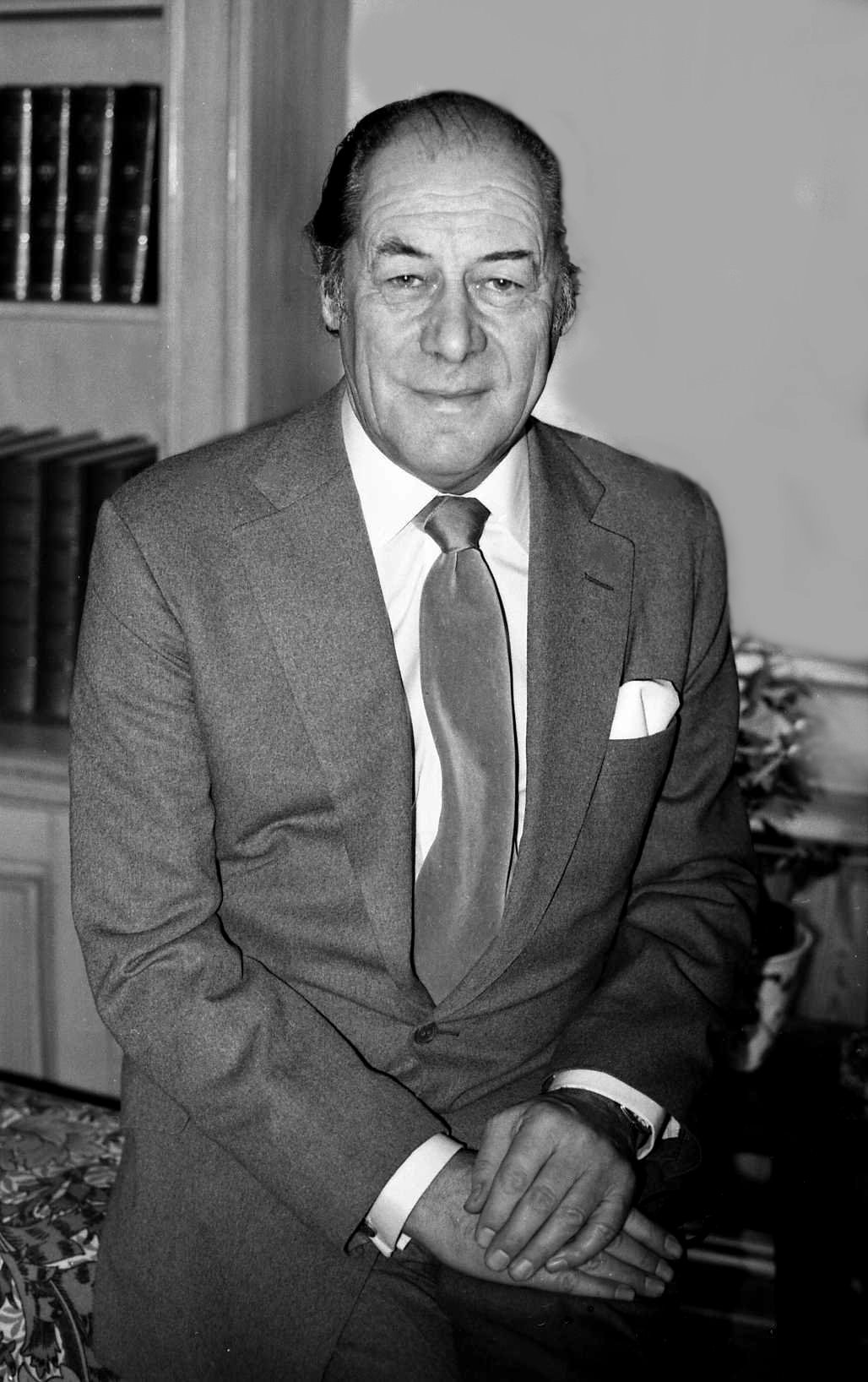
Showing posts with label Rex Harrison. Show all posts

Sunday, 13 March 2022

Movie Review: The Yellow Rolls-Royce (1964)

A star-infused anthology drama, The Yellow Rolls-Royce features three distinct European-set adventures linked by one vehicle. The stories toil towards stodgy adequacy.

The opening segment is set in London of the 1920s. The wealthy Charles, Marquess of Frinton (Rex Harrison) of the British Foreign Office purchases a brand new yellow Rolls-Royce as an anniversary gift for his wife Eloise (Jeanne Moreau). He is looking forward to fielding the favourite horse at Ascot's Gold Cup, but Eloise is having an affair with diplomat John Fane (Edmund Purdom).

The second and longest story is set in Italy's Genoa area in the 1930s. Mafioso Paolo Maltese (George C. Scott) buys the Rolls-Royce when his moll Mae Jenkins (Shirley MacLaine) falls in love with it. She has no appreciation for culture, but gigolo tourist photographer Stefano (Alain Delon) catches her attention. When Paolo is called back to the United States, Mae and Stefano pursue an affair under the watchful eye of Paolo's right-hand man Joey Friedlander (Art Carney).

The final instalment starts in Italy near the border with Yugoslavia in 1941. Wealthy and influential American widow Gerda Millett (Ingrid Bergman) purchases the aging Rolls-Royce to drive into troubled Yugoslavia and meet the newly installed leader. Partisan Yugoslav commander Davich (Omar Sharif) is aware the Nazis are about to invade his country, and spots an opportunity to slip across the border in the vehicle's trunk.

A British MGM studios production, The Yellow Rolls-Royce labours away with plenty of verbiage yielding relatively limited impact. Writer Terence Rattigan demonstrates a propensity for long paragraphs of irrelevant dialogue, and despite the short length of each segment, the film gets bogged down in long scenes digging away at the obvious. To compensate, director Anthony Asquith makes good use of scenic European locations, and when all else fails, the yellow Rolls-Royce itself adds elegance to any frame.

As expected the format reveals interesting ideas beset by insufficient evolution. The third chapter is energized by the World War Two context and carries the most promise as a potential long-form drama. Finally the Rolls-Royce is put to use for something other than discrete love-making, as Ingrid Bergman's Gerda descends from haughty pretensions and helps partisans re-group in the mountains. 

The middle story is the longest, occupying half the two hours of running time, but remains in middling territory. Shirley MacLaine tries hard as the American hat-check girl and a fish out of water in Italy, Alain Delon the only piece of culture she is interested in. George C. Scott over-cooks his mafia boss into a cartoon character. Art Carney is more circumspect as the aging deputy and driver.

The first story is the weakest, all pomp and circumstance with Rex Harrison in his theatrical element. Asquith stages a lavish banquet then enjoys the Ascot surroundings, leaving limited room for the central illicit love affair.

The common themes across the three chapters include secretive love affairs and characters exposed to both stark realities and trajectory-changing revelations. The Yellow Rolls-Royce is gracefully staid, and perhaps unsurprisingly, never moves out of third gear.


All Ace Black Movie Blog Reviews are here.

Monday, 11 May 2020

The Movies Of Rex Harrison


All movies starring Rex Harrison and reviewed on the Ace Black Movie Blog are linked below:


All Ace Black Movie Blog reviews are here.
The Movie Star Index is here.

Sunday, 3 May 2020

Movie Review: The Agony And The Ecstasy (1965)


A historical drama about the creation of one of the world's most famous artefacts, The Agony And The Ecstasy lacks subtlety but overflows with admirable passion.

The film opens with a 12 minute documentary about Michelangelo's rise from humble beginnings in Florence to celebrated status as the leading sculptor of the Renaissance era. The story then starts in Rome of the early 1500s, with Michelangelo (Charlton Heston) working on a commission for Pope Julius II (Rex Harrison) to create 40 sculptures for the Pope's future mausoleum.

The Pope is leading his armies in battles to unify various restless regions under the papal flag. He switches Michelangelo's attention to the Sistine Chapel, requesting ceiling paintings of the twelve apostles. Michelangelo is hesitant and uninspired, insisting he is a sculptor and not a painter. After starting the work he defaces the early images and abandons the commission.

After a period of seclusion Michelangelo returns with a new premise to transform the chapel's ceiling with imagery related to the creation of humanity. The Pope is impressed, but the work takes a long time, again creating tension between the two men. The strain impacts the artist's health, while the Pope's wars take a turn for the worse and his supremacy is challenged.

A grand adaptation of one chapter in Irving Stone's book with a script by Philip Dunne, The Agony And The Ecstasy does not hold back on conveying a sense of art history in the making. With studio 20th Century Fox aiming for a spectacularly-scaled production, director Carol Reed is sometimes lost attempting to capture the intimate process of artistic genius creativity under widescreen, vivid colour, big-set requirements. The dubious decision to also deliver an art history lesson does not help.

And so the film rides ups and downs for 140 minutes, good intentions and a committed attitude often prevailing. The best scenes by far are the more intimate interactions between Michelangelo and Julius. The two men often infuriate each other, but a mutual respect underpins their commercial relationship, and as the film progresses something resembling a deep friendship emerges. Reed finally nails his crescendo, not in any epic shot but with the two men alone and quietly discussing the meaning of life and faith underneath the newly painted The Creation of Adam.

Earlier, the special effects team conjures up a satisfyingly spectacular sunlight-and-cloud formation to inspire the artist out of his doldrums, and Reed weaves in scenes at the Carrara quarry for eye-popping recreations of the marble extraction process.

Elsewhere the supporting cast is sidelined and underpowered. Harry Andrews features as papal architect Bramante, while Tomas Milian is up-and-coming artist Raphael, a potential rival for Michelangelo. Adolfo Celi is Cardinal Giovanni de' Medici, future pope and here portrayed as the artist's father figure. The Cardinal's daughter Contessina Antonia (Diane Cilento) is a smart and resourceful but half-hearted love interest.

The overall historical context is also patchy. Julius II is known as the Warrior Pope, and the film features several scenes of battle preparations and brief skirmishes. But beyond vague references to tensions with France, cities in rebellion and enemies circling Rome, Dunne and Reed are uninterested in further expounding on the causes behind the War of the League of Cambrai.

The Agony And The Ecstacy takes its title to heart. The emotions are often overheated, the arguments loud and impassioned, admiration and fury separated by thin margins. In this imagining of timeless art under gestation, there are no half measures.


All Ace Black Movie Blog reviews are here.

Wednesday, 18 March 2020

Movie Review: Night Train To Munich (1940)


A spy adventure, Night Train To Munich creates the fundamentals of a good thriller but mixes in an excess of unfortunate frivolity.

It's 1939, and the Nazis invade Czechoslovakia. Unwilling to work for the Germans, Czech armour-plating scientist Axel Bomasch (James Harcourt) escapes to England, but his daughter Anna (Margaret Lockwood) is caught and imprisoned in a concentration camp. The Nazis believe she will lead them to Axel's whereabouts, and Gestapo Captain Karl Marsen (Paul Henreid) dupes her into a staged escape and lands with Anna in Britain.

With the help of British Intelligence Officer Dickie Randall (Rex Harrison) Anna indeed locates her dad in the small seaside community of Brightbourne. Karl pounces and captures both Axel and Anna, returning them to Germany via U-Boat. Randall has a narrow window of opportunity to extract the scientist and his daughter before they are transferred to Munich. He pretends to be Major Ulrich Herzog of the Corps of Engineers and infiltrates the Nazi bureaucracy to attempt a dangerous rescue.

Approximately half of a very good film, Night Train To Munich is Hitchcock light. The spy versus spy adventure includes a lukewarm romance, some humour and plenty of subterfuge, but the story becomes more absurd with every passing scene, straining credibility even by jovial genre standards.

Director Carol Reed keeps the action moving briskly, leading to the reasonably engaging set-piece journey on an overnight train between Berlin and Munich. England declares war on Germany that night, and Randall's mission is suddenly much more dangerous, with his ruse of pretending to be a German officer already fraying at the edges.

But here Reed stumbles. The marginal characters of English travelers Charters and Caldicott crash the story quite late into the film and suddenly start to burn many minutes of screen time with their lighthearted but irritable Englishmen abroad banter. Their side-character intervention deflates all the built-up tension and momentum, and Night Train To Munich never recovers.

Reed makes an attempt at amends with a final 15 minutes featuring an almost literal cliffhanger, placing the doofus sidekicks back into a box and delivering a well-executed climax straight out of the Hitchcockian playbook.

The performances are adequate, with Paul Henreid (billed as Paul von Hernried to amplify his German credentials) overshadowing Rex Harrison. Lockwood is more prominent than Harcourt, but both are primarily victims of swirling events around them and barely leave an impression.

Clever, improbable and uneven, Night Train To Munich offers mixed scenery.


All Ace Black Movie Blog reviews are here.

Sunday, 4 March 2018

Movie Review: Midnight Lace (1960)


A psychological suspense thriller, Midnight Lace is reasonably effective but also repetitive and predictable.

Kit (Doris Day) is an American living in London and recently married to Tony Preston (Rex Harrison), a senior executive at the investment company that carries his family name. Walking home alone in the thick fog one day Doris hears a menacing voice threatening her with death. Soon she starts receiving harassing phone calls. With Tony always busy work, neighbour Peggy (Natasha Perry) tries to help, and the arrival of Aunt Bea (Myrna Loy) for a visit provides some comfort, but the threats continue.

Kit and Tony reach out to Scotland Yard and Inspector Byrnes (John Williams) starts to investigate. Contractor Brian Younger (John Gavin) is working on a construction site next to the Prestons' apartment and seems to have his eye on Kit. Malcolm Stanley (Roddy McDowall) is the good-for-nothing son of the Prestons' housekeeper, always on the lookout for money. And a mysterious man in a black suit and black hat is continuously hovering in the neighbourhood. But when no suspects are apprehended, Kit starts to question her own sanity.

An adaptation of the play Matilda Shouted Fire by Janet Green, Midnight Lace is directed by David Miller and features glossy sets, lavish costumes and handsome London locations. The film shows no signs of being held captive by the stage origins, and Miller along with script writers Ivan Goff and Ben Roberts conjure up a good-to-look-at and fairly engaging mystery. The cinematography is dynamic, and Miller is alway on the lookout for the more interesting angle to shoot from.

But despite the gloss, the story carries echoes of Gaslight, and once the premise is set, the film stumbles with repetitive scenes of Kit receiving the next threat and reacting with hysterics. Miller makes a couple of mistakes: the voice on the other end of the phone is rarely heard, and while this is intended to raise doubt as to whether Kit is dealing with reality or not, the muting of the aggressor defangs the suspense level. Doris Day can only widen her eyes and scream so many times before tired duplication sets in.

The other misstep is in the pacing, and as much as the middle section of the film sags, the ending is rushed, unbalanced and clumsy, featuring the unnecessary traversing of construction scaffolding but not enough exposition to tidy up plenty of loose ends. Some characters disappear, others are introduced in a late muddle and what was a relatively cerebral plot deflates.

There is enough in Doris Day's performance to suggest her career would have benefited from more dramatic roles, and Rex Harrison is sturdy as the husband torn between work duties and an increasingly frantic wife. The supporting cast is unusually strong but also underutilized. Myrna Loy, Roddy McDowall, John Gavin and John Williams could all have benefited from having more to do.

Midnight Lace may not carry its momentum all the way through, but although the tension diminishes, the sleek packaging endures.


All Ace Black Movie Blog reviews are here.

Monday, 1 January 2018

Movie review: Cleopatra (1963)


A mammoth historical epic, Cleopatra is a mind-numbing and emotionally frigid four hours filled with grand sets, numerous colourful costumes and endless but hollow spectacle.

Julius Caesar (Rex Harrison) chases his defeated rival Pompey to Egypt, where he quickly gets embroiled in the raging civil war over control of the throne between the immature Ptolemy and his conniving but alluring sister Cleopatra (Elizabeth Taylor). Keen to re-establish stability to ensure the continued flow of natural resources from Egypt, Caesar sides with Cleopatra. She has grander plans, and proceeds to seduce Caesar and bear his child with ambitions for them to jointly rule the world.

Cleopatra makes the grandest of entrances on a state visit to Rome, during which she catches the eye of Caesar loyalist Mark Anthony (Richard Burton). But Caesar's ascension to absolute power is rudely interrupted on the Ides of March, forcing Cleopatra to retreat to Egypt. Rome is plunged into a civil war from which Mark Anthony and Caesar's appointed successor Octavian (Roddy McDowall) emerge victorious. Mark Anthony arranges a meeting with Cleopatra to re-establish ties, triggering a steamy affair as again she plots to expand her powers through the art of seduction.

One of the most troubled and expensive productions in Hollywood's colourful history, Cleopatra almost bankrupted 20th Century Fox. No shooting script, a change in filming location from England to Italy, a change in director with Joseph L. Mankiewicz taking over from Rouben Mamoulian, and extensive delays caused by Elizabeth Taylor falling severely ill resulted in an out-of-control fiasco.

But all the public cared about were reports of a scandalous on-set affair between Taylor and Richard Burton, both married to others at the time. Cleopatra became a must-see event for the notoriety of its stars, and despite ending the year as the box office champion, it still lost enormous amounts of money due to the massive (at the time) $33 million production cost.

After a post-production process during which he was fired and then re-hired (the script only existed in his head), Mankiewicz delivered a 6 hour cut and pleaded for the release of two separate three-hour films: Caesar And Cleopatra to be followed by Anthony And Cleopatra. Aware of public desire to see Taylor and Burton together immediately, the studio insisted that Mankiewicz deliver one four-hour film.

The result is a bloated mess. Extraordinarily talkative and exhaustively long, the film lumbers forth sometimes incoherently at a plodding pace. Characters come and go sometimes at random, important events appear to be skipped entirely or barely explained, characters are vacuous, and the few action scenes consist of colossal build-ups followed by limp and clumsy execution.

What survives are the lavish sets that serve as backdrops to all the talking, and the parlour game of Taylor changing outfits (and especially wigs and hairdos) every few minutes. For followers of fashion, hairstyles and cleavage, there is always something to see, and on a few occasions the film gets distracted with circus-like interludes, dancers, performers, and general merriment taking over the screen and killing off whatever narrative momentum may have been building.

With creaky and overwrought lines of dialogue, Cleopatra's seductive powers and the passion between her and two powerful men never make it onto the screen. The loosening of censorship restrictions allowed Mankiewicz to ensure Taylor and her maidens are always alluring, but then the talking kicks in and any sense of enticement and adoration is lost in the suffocating verbiage.

With the exception of Rex Harrison, the performances are best described as vacant. The actors don't appear invested in what just happened previously and what will happen next (either because they did not know or it was all lost in the editing) and so every scene is a tedious stand-alone melodramatic piece, emotionally detached from every other scene.

Harrison is a notable cut-above, inserting an edge of confidence and sardonic humour in his performance as Caesar, and the film's second half without him is much the poorer. Roddy McDowall as Octavian is the only other standout performer, perhaps over-the-top but suitable as an impressively calculative leader.

Cleopatra's entrance into Rome is an admittedly impressive piece of cinematic extravagance. But like the rest of the film, it's a display of indulgent pageantry without soul.


All Ace Black Movie Blog reviews are here.

Saturday, 21 October 2017

Movie Review: My Fair Lady (1964)


A musical drama and romance, My Fair Lady is a lavish, joyful story filled with social satire and wondrous songs.

London, in the early 1900s. Phonetics Professor Henry Higgins (Rex Harrison), a conceited confirmed bachelor, stumbles upon young Cockney flower seller Eliza Doolittle (Audrey Hepburn). A strong believer that language skills determine status, Higgins accepts a challenge from his colleague Colonel Pickering (Wilfrid Hyde-White) that he can transform Eliza into a classy society woman within six months by improving her oration. Not quite knowing what she is getting herself into, Eliza accepts and moves into Higgins' home, and he initiates round-the-clock training.

Eliza's good-for-nothing perpetually unemployed father Alfred (Stanley Holloway) senses an opportunity to make some money off Higgins. Meanwhile, Eliza finally makes a breakthrough in her pronunciation skills and Higgins starts to test her in social circles, including interactions with his mother Mrs. Higgins (Gladys Cooper) and a young potential beau Freddy (Jeremy Brett). Eliza starts to develop feelings for Higgins despite all his faults, but his supreme arrogance gets in the way.

An adaptation of the Pygmalion-inspired stage musical conceived by lyricist Alan Jay Lerner and composer Frederick Loewe, the film version of My Fair Lady succeeds in translating the show onto film with a rich aura of grandeur. Extravagantly directed by George Cukor, the film features magnanimous sets and splendid costumes to go along with George Bernard Shaw's acerbic commentary on England's classism.

The highlights are many, built around some of the best and most famous songs to make it into a film musical. As is commonly the case in musicals the first part is by far the stronger, and Cukor hits a stunning purple patch including Eliza dreaming about a better life in Wouldn't It Be Loverly, Alfred espousing the skills of doing nothing in With A Little Bit Of Luck, and then reaching a climax with the stunning double back-to back peaks of The Rain In Spain and I Could Have Danced All Night.

The most biting sequence in terms of sharp wit occurs during Eliza's first planned sojourn into the world of the wealthy at the Ascot races. Cukor stages the Ascot Gavotte with delightful discipline, laying bare the habits of the affluent yet ridiculous class, where every movement is measured and critiqued but nevertheless absurd. Eliza will never fit in with these people, and nor would she want to.

After the intermission, the songs take a break and visual splendor takes over, as Cukor unspools an effusive embassy ball scene, a standard-setting affair with sparkling costumes and matching behaviour in ballrooms and hallways filled with highbrow diplomats, royalty, military types, intelligentsia and glitterati.

With a mammoth running time of 170 minutes, the film of course has its faults. Higgins gets too many similar songs. Why Can't The English Learn To Speak, An Ordinary Man, You Did It, and Why Can't A Woman Be More Like A Man are all fine but also all too similar, hammering away at overlapping narcissism themes and pushing Higgins' characters towards an almost unsalvageable corner. The second half does inevitably sag, although it would have been miraculous had the momentum of the sterling opening 100 minutes been sustained.

Despite having her singing dubbed by Marni Nixon, Audrey Hepburn sparkles with wit and honesty, and carries the Cecil Beaton designed costumes with remarkable grace. Whether as a Covent Garden flower girl or as a tentative debutant on the elite social scene, the role of Eliza is a prominent jewel in Hepburn's extraordinary career crown. Rex Harrison matches her with a performance full of self-satisfied bombast.

My Fair Lady is traditional Hollywood at its finest, putting on a no-expenses-spared show with the stars shining bright.


All Ace Black Movie Blog reviews are here.

Friday, 3 April 2015

Movie Review: The Ghost And Mrs. Muir (1947)


A fantasy romance set in England, The Ghost And Mrs. Muir is a charming love story between a lively young widow and the crusty ghost of a dead sea captain. The absurd premise works ridiculously well.

It's early in the 1900s, and one year on from the death of her husband Lucy Muir (Gene Tierney) is fed up living with her stifling in-laws in London. She packs up her daughter Anna (Natalie Wood) and housekeeper Martha (Edna Best) and heads to the coast. She tangles with real estate agent Mr. Coombe (Robert Coote) and insists on renting Gull Cottage, a long-abandoned estate known to be haunted. Lucy soon encounters the ghost of Captain Daniel Gregg (Rex Harrison), the former owner of the house. He tries to scare her away but she is unmoved, and they soon negotiate a co-existence deal: he will allow her to stay in the house as long as she allows him to peacefully haunt her bedroom (formerly his room) at will, and he stays away from scaring Anna.

Over the following weeks and months the Captain and Lucy get to know each other, he calls her Lucia and she learns about his love of the sea and his eventful, adventurous life. When she hits a financial crisis he inspires her to write a book about his life. But when Lucy meets the attractive Miles Fairley (George Sanders), a successful author of children's books, the relationship between the ghost and Mrs. Muir is further complicated.

Directed with a deft touch by Joseph L. Mankiewicz, The Ghost And Mrs. Muir is a whimsical tale of impossible love serving as inspiration for a life change. An adaptation of the novel by R. A. Dick, the film strikes all the right notes. Instead of slipping into contrived drama or overwrought emotions, the film draws inspiration from the gorgeous yet rugged setting and confidently strides in self assured directions, pushing boundaries wherever it can.

The two central characters offer genuine emotional depth, and elevate the film from romance to an inquisitive exploration of life's opportunities, gained and lost. Lucy Muir is a feisty heroine who stares down the scare tactics of a ghost and pushes back to create a mutually respectful relationship. The presence of a ghost is treated as a matter of fact, and the Captain never compromises his salty language and manly ideals, but still finds the space to graciously accommodate a woman in his estate and his heart.

Mankiewicz cleverly allows the film to play both as a romantic fantasy and a psychological case study. Of course the prolonged interaction with the ghost may just be a creation of Lucy's mind to focus her courage, as a young woman breaking all the social norms and setting off on her own in a conservative society. Whether present as a ghost or as merely a prevailing influence in the new surroundings, Captain Gregg serves as inspiration and motivation, prodding Lucy onwards to confront her fears, define her own life, achieve financial independence and dare to again interact with men.

Miles Fairly finally emerges as the first potential opportunity for Lucy to find a suitable real man, and the lessons learned from the Captain will serve her well in dealing with forthcoming emotional upheavals. Regardless of Fairly's attributes, Lucy now has a high standard to measure him against.

Gene Tierney and Rex Harrison allow the film to sparkle, creating a compelling couple and finding the strangest chemistry built on contrast, a combustible mix of stubbornness, honesty and admiration. He is supposed to be gruff, she is supposed to be fragile, but Tierney and Harrison delve into the complexities below the surface to find the independence that binds the characters.

George Sanders arrives relatively late and adds the heartfelt passion of an author who is perhaps too eager to add excitement to a life he perceives as dull. Edna Best is excellent as the housekeeper who is also a lifelong and trusted companion, while Natalie Wood in an early role is amiable as young Anna.

Bernard Herrman conjures up one of his most celebrated music scores to augment the romance, contributing enormous depth to the majestic setting of a seaside house witnessing a poignant love. The Ghost And Mrs. Muir then goes on to offer one of the all-time weepiest and most bittersweet endings, a triumph of the souls that lives on for the ages.


All Ace Black Movie Blog reviews are here.