Saturday, 29 March 2025
Movie Review: Wicked Little Letters (2023)
Friday, 2 August 2024
Movie Review: Empire Of Light (2022)
Genre: Romantic Drama

All Ace Black Movie Blog reviews are here.
Sunday, 1 May 2022
Movie Review: The Father (2020)
Anthony (Anthony Hopkins) is in his eighties, and lives in London. Suffering from creeping dementia, his perception of the world is muddled. He either lives in his own flat and is visited by his daughter Anne (Olivia Colman), or he lives in her flat with her husband Paul (Rufus Sewell), or her ex-husband.
Anne may or may no be relocating to Paris. She tries to arrange a caregiver who can withstand Anthony's crustiness, and the latest applicant Laura (Imogen Poots) looks a lot like Anthony's other daughter Lucy, an artist. Anthony overhears conversations, frequently misplaces his watch, has difficulty remembering people and events, senses he is not welcome, and suspects Anne and her husband may want to place him in a care home.
Director Florian Zeller adapts his own play to the screen, and along with co-writer Christopher Hampton they produce a taut 97 minute journey into the black hole of mental deterioration. The Father is not an easy watch: mental illness degrades the essence of what it means to be human, and is horrendous for both patient and caregivers. The outcome is predetermined but the schedule is not, increasing the suffocating sense of frustration.
In a rare example of a play being potentially even better suited to the cinematic experience, Zeller sets out to disorient and confuse with a cold and calculating style. It does not take long for The Father to settle into a rhythm of confounding unreliability. Anthony's every interaction is suspect, because in his world time, people, places, and events fold onto each other. The audience's instinct is to try and understand, to piece together the fragments of routine conversations. Did Anne buy that chicken or not? Is Anthony living at his flat or at Anne's place? Is she moving to Paris or not?But the answers change according to each scene, Anthony's mental state now consisting of unconnected dots floating in non-linear space. The functional here-and-now part of his brain works overtime to cover for his deficiencies, but it's a losing battle, victimizing the people who want to care for him the most. Just occasionally a lucid moment slips through, nourishing the Herculean effort needed to get through the next hour.
In a career crowning performance, Anthony Hopkins occupies Anthony's humiliation with a mixture of defiance and arrogance, but allows the fear and fragility of bewilderment to reside close to the surface. Olivia Colman captures the grief bordering on resentment of a family member exhausted by the realization her best may be far from good enough.
The Father does not seek nor find moments of happiness, but it does contribute to better understanding and deeper appreciation of acute distress.
All Ace Black Movie Blog reviews are here.
Wednesday, 5 January 2022
Movie Review: The Lost Daughter (2021)
Middle-aged literature professor Leda Caruso (Olivia Colman) of Cambridge, Massachusetts, arrives for a vacation in Greece. She takes a room at the hotel managed by grizzled American Lyle (Ed Harris). At the nearby small beach where Will (Paul Mescal) runs the concession, Leda observes vacationing young mom Nina (Dakota Johnson) struggling with her demanding daughter Elena. Nina reminds Leda of her own frustrating days as a young mom (Jessie Buckley) juggling graduate studies with caring for two daughters.
Nina is part of a vacationing family from Queens with roots in Greece. Her shifty husband Toni (Oliver Jackson-Cohen) controls businesses in the area, and is frequently absent, leaving Nina bored and interested in Will. Nina's sister Callie (Dagmara DomiĆczyk) is pregnant, and her direct conversational style clashes with Leda's desire for solitude. Elena briefly goes missing at the beach, causing momentary panic. Leda intervenes, inserting herself into Nina's orbit while memories of the past continue to haunt her.
An excellent directorial debut for Maggie Gyllenhaal, The Lost Daughter is a soulful treatise on womanhood and the burden of childcare. Gyllenhaal adapted the novel by the anonymous Italian writer Elena Ferrante, and with help from a mesmeric Olivia Colman focuses beautiful lyricism on often neglected topics.
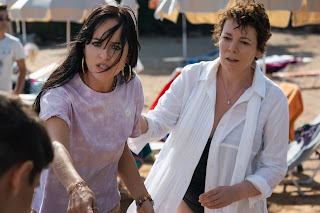
The intersecting experiences of Leda, Nina and Callie explore motherhood from the multiple prisms of the past, present, and future, resulting in an impressive narrative scope. Mothers' insecurities, unsatisfied desire, and sense of inadequacy, along with the incessant demands of children, husbands getting away with doing less, and the seeming impossibility of juggling parenting with a career, all surface in haunting shadows. Leda observes Nina embarking on a familiar path, then moves from quiet bystander to a version of meddling, driven by a complex mix of caring, selfishness, arrogance, and self-righteousness. The past and present come together, Gyllenhaal interspersing the flashback scenes in just the right doses to artfully round Leda into a genuine and memorably flawed individual.The drama unfolds through powerful naturalistic behaviours and familiar human dynamics. The vacationing Leda is not much of a people person, and a lot of what happens in Greece is conveyed through silent pauses. Olivia Colman expresses a range of emotions by under-communicating, Leda pulling back into a stern stance when faced with Callie's inquisitions. Her sense of entitlement does erupt in petty self-defeating episodes, first refusing to relocate her beach position to accommodate a family's needs, later picking a fight she cannot win with a group of disruptive youth.
Sexual desire at various life stages is another common theme. Young Leda and Nina are both unsatisfied with their husbands, and as they navigate child care responsibilities, they both seek better male companionship. And now Leda finds men like Lyle and Will potentially interested in her as a project and an enigma, but not necessarily as a person.
At 121 minutes the movie is marginally over-long, some scenes repeating the same notes, others altogether unnecessary. But in the final act, Leda's motivations and self-awareness come into sharp focus. In a moving acknowledgement of frailty, The Lost Daughter couples crushing responsibility with disruption of emotional balance, the consequences rippling into the future.

All Ace Black Movie Blog reviews are here.
Saturday, 29 December 2018
Movie Review: The Favourite (2018)
A British royal drama and comedy, The Favourite delves into a three-way power struggle in the court of Queen Anne.
It's the early 1700s, and Queen Anne (Olivia Colman) is in poor health as England is engaged in a war with France. Her confidant and advisor Sarah Churchill (Rachel Weisz) is the real power behind the throne, and takes charge of all important decisions, including issuing instructions to leading politician Sidney Godolphin (James Smith) and opposition leader Robert Harley (Nicholas Hoult).
Sarah's cousin Abigail Hill (Emma Stone) secures a job as a kitchen servant at the palace, and soon graduates to Sarah's personal assistant after demonstrating initiative in helping treat the Queen's painful gout. But Abigail has grander ambitions, and once she uncovers exactly how close Sarah is to Anne, she sets out to displace her cousin as the Queen's favourite.
Directed by Yorgos Lanthimos and written by Deborah Davis and Tony McNamara, The Favourite is inspired by history, but adds plenty of embellishment. This is a story of ambition and a grab for power and social status, peppered with hefty doses of politics and illicit lust. And it's a narrative dominated by women, here holding the reigns and seeking advancement, the men reduced to navigating around them with varying levels of success.
While the story is original and the invented sexual zip adds shock value to the staid royal surroundings, the film is an in-your-face stylish marvel. Lanthimos uses fisheye lenses set in room corners to achieve voyeuristic perspectives, and often fills the screen with wide spaces but not many people to convey a sense of grand places and the burdens of monarchy. A few women are making all the decisions in this court, and they will discover, in turn, that it is lonely at the top.
Natural, candle and backlighting complete the unique visual aesthetic, while the music score is equally inventive, often irritating, but never subdued. The dialogue is injected with unexpected doses of modern brashness, serving as lighting strikes of humour but also bringing the characters down to earth from their traditional contemptuous royal airs.
The words are brought to life by three actresses in top form. Olivia Colman displays vulnerability as the hobbled Queen barely able to walk, her determination to actually rule functioning only sporadically. Rachel Weisz dominates as Sarah, her performance a study in the single-minded understanding of manipulation. And Emma Stone gets the most complex role, starting out as the wide-eyed mud-covered servant girl and methodically working her way towards the power nexus.
The combination of an unbecoming palace squabble and idiosyncratic presentation results in a weird cinematic experience, oscillating between awkward, bizarre and fascinating. Lanthimos' drive to be different is not always on target, but it is never dull.
All Ace Black Blog Movie Reviews are here.