Showing posts with label Kristen Stewart. Show all posts

Tuesday, 13 January 2026

Movie Review: Happiest Season (2020)


Genre: Romantic Comedy  
Director: Clea DuVall  
Starring: Kristen Stewart, Mackenzie Davis, Alison Brie, Aubrey Plaza, Mary Steenburgen, Victor Garber, Daniel Levy  
Running Time: 102 minutes  

Synopsis: Abby (Kristen Stewart) is planning to propose marriage to her girlfriend Harper (Mackenzie Davis), and agrees to spend Christmas at the home of Harper's wealthy parents. On the way, Harper reveals that she has not yet told her parents (Victor Garber and Mary Steenburgen) that she's gay. Abby plays along, pretending to be Harper's roommate, and meets Harper's sisters (Alison Brie and Mary Holland), a secret lover from high school days (Aubrey Plaza), and a former boyfriend. With Harper acting straight, Abby feels neglected, and her gay friend John (Daniel Levy) arrives to help.

What Works Well: The stellar cast extracts best value out of the limited material. The individual and sometimes difficult coming out journey is handled with notable sensitivity, here placed in the context of offspring struggling to meet lifelong parental expectations and the imperative to project a "perfect" family image (Harper's father wants to run for Mayor). 

What Does Not Work As Well: The entire premise is built on the rickety foundation of Harper inviting her partner to meet her parents, but before telling them she's gay. The contrivances get worse when Harper emotionally abandons Abby and starts flirting with her ex-boyfriend. After a significant investment in multiple difficult family dynamics (Harper's two sisters have serious issues of their own), the resolutions quick snap back to convenient outcomes.

Key Quote:
John (to Abby): You deserve to be with someone who shouts their love for you from the rooftops!


All Ace Black Movie Blog reviews are here.

Sunday, 12 October 2025

Movie Review: Billy Lynn's Long Halftime Walk (2016)


Genre: War Drama  
Director: Ang Lee  
Starring: Joe Alwyn, Steve Martin, Vin Diesel, Chris Tucker, Garrett Hedlund, Kristen Stewart  
Running Time: 113 minutes  

Synopsis: After performing heroics during a firefight in Iraq, 19 year-old US Army Specialist Billy Lynn (Joe Alwyn) is on a two-week publicity tour of the United States along with his Bravo company members. In the lead-up to an appearance at the glitzy half-time show of a Dallas football game, Billy recalls the war experiences that led to death of his Sergeant "Shroom" (Vin Diesel). In the meantime a publicity agent (Chris Tucker) is trying to secure a movie deal for Bravo, the football team owner (Steve Martin) is eager to share in the glory, Billy's sister Kathryn (Kristen Stewart) wants to convince him to avoid re-deployment, and a cheerleader (Makenzie Leigh) shows a romantic interest.

What Works Well: This reflective drama delivers a blunt anti-war message with impressive visuals, while simultaneously saluting the soldiers dispatched to do the dirty work. Director Ang Lee seeks a sense of geographic disorientation among the Bravo team members, paraded onto a stage where they don't belong and exploited by wealthy men willing to underbid for unearned glory. Despite the surrounding razzmatazz, the clock is ticking towards the men's redeployment back to the hell of war, not that anyone on the home front cares beyond Billy Lynn's sister.

What Does Not Work As Well: More a message than a movie, the plot is directionless and never gains momentum. The Billy Lynn character provides insufficient weight to carry the narrative, and the collective group of soldiers is not much more than a compilation of banter and hijinks. The two most interesting characters are the mythology-inspired Shroom (already dead) and the grounded Kathryn (reduced to a couple of scenes).

Key Quote:
Billy: It's sort of weird, being honored for the worst day of your life.


All Ace Black Movie Blog reviews are here.

Monday, 7 April 2025

Movie Review: Love Lies Bleeding (2024)


Genre: Romantic Crime Drama  
Director: Rose Glass  
Starring: Kristen Stewart, Katy O'Brian, Ed Harris, Jena Malone, Dave Franco  
Running Time: 104 minutes  

Synopsis: In rural New Mexico of 1989, gym manager Lou (Kristen Stewart) falls in love with muscular drifter-from-out-of-town Jackie (Katy O'Brian), who is planning to compete in a Las Vegas body building competition. Jackie accepts a job at the shooting range managed by Lou's estranged father Lou Sr. (Ed Harris), and starts to inject herself with large doses of steroids. Meanwhile Lou's sister Beth (Jena Malone) is being abused by her sleazoid husband JJ (Dave Franco). When the abuse goes too far, Jackie intervenes, triggering a cycle of violence.

What Works Well: Director and co-writer Rose Glass creates a sweaty and gritty genre-melding backwater drama. Against the backdrop of corruption (Lou's father) and exploitation (Lou's brother-in-law), a romance blossoms and hopes for Vegas glory spur optimism, but drug-fueled violence leads to neo-noir shadings and even moments of levity. The cast excels within the economic doldrums (Jackie is effectively homeless; Lou's main task as gym "manager" is to clear clogged toilets), and Kristen Stewart exudes intent as a protagonist emerging from passivity.

What Does Not Work As Well: The final act is buffeted by too many dead bodies and erratic tonal shifts, undermining the more subtle set-up work. The sub-story about the FBI's investigation into Lou Sr.'s shady criminal activities receives only half-hearted attention.

Key Quote:
Jackie: Anyone can feel strong hiding behind a piece of metal. I prefer to know my own strength.


All Ace Black Movie Blog reviews are here.

Saturday, 11 February 2023

Movie Review: Seberg (2019)


Genre: Biographical Drama
Director: Benedict Andrews
Starring: Kristen Stewart, Jack O'Connell, Anthony Mackie, Vince Vaughn
Running Time: 102 minutes

Synopsis: In the late 1960s, actress Jean Seberg (Kristen Stewart) is attracted to the black civil rights movement and starts a passionate affair with activist Hakim Jamal (Anthony Mackie). She also donates to the Black Panther group, prompting the FBI to intrude into her life with agents Solomon (Jack O'Connell) and Kowalski (Vince Vaughn) mounting surveillance. Seberg's marriage to Romain (Yvan Attal) crumbles and she experiences paranoia, but refuses to betray her beliefs even as the government ramps up pressure. 

What Works Well: The opening act captures the whirlwinds of an era dominated by social turmoil, sucking in an idealistic but troubled and naive actress eager to gain publicity and satisfy carnal urges. The unchecked ability of a powerful government agency to tamper with a citizen's life is portrayed with cold detachment. The set designs and outfits capture a late 1960s vibe, and Kristen Stewart owns the narrow range between sullen and angry.

What Does Not Work As Well: The second half of the film stalls, with Seberg stuck in a dark emotional space and the unformed side-stories of the FBI agents intruding into the spotlight. Precious little background is revealed about Seberg to explain her activism and mental health issues, and selective scrubbing reduces civil rights leaders to polite cocktail party fundraisers. In any event, the black power plot driver unceremoniously fades away.

Conclusion: Occasionally potent portrait of a celebrity wading into trouble, but falls short of the intended searing social commentary.


All Ace Black Movie Blog reviews are here.

Sunday, 6 February 2022

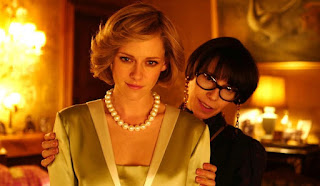
Movie Review: Spencer (2021)

A study of loneliness and looming depression, Spencer delves into the mind of the planet's most famous woman trapped in an inhospitable world.

December 1991. The British royals assemble at Sandringham Estate to celebrate Christmas. Her Royal Highness Princess Diana (Kristen Stewart) arrives alone, feeling detached from the rest of the family. She now knows her husband Prince Charles (Jack Farthing) is having an affair, and she is stifled and repelled by the cold and meticulously orchestrated traditions.

Over three days, Diana battles bulimia and only finds joy in the company of her young boys William and Harry. She interacts with head chef Darren (Sean Harris) and equerry Major Alistair Gregory (Timothy Spall), but the only servant she trusts is her dresser Maggie (Sally Hawkins). As she reads a book about the ill-fated Anne Boleyn, Diana's erratic behaviour intensifies and she becomes ever more desperate to break free. Her late father's next-door estate offers a tantalizingly close emotional escape to happier memories.

Spencer imagines Lady Diana's gradual but necessary royal deconstruction as a process towards discovering a new path. Writer Steven Knight is solely focused on the real woman beneath the public legend, and director Pablo Larrain unceremoniously shreds away all pomp and ceremony: the rest of the royal family members and all their choreographed movements are pushed into the deep background, now just a ridiculous sideshow amplifying Diana's agony.

What remains is a searing journey into a distressed soul, with the cold walls closing in. Lost in her own country (literally, at the start of the movie), betrayed by her husband, close to being labelled an outcast, and sensing nothing but disdain from family members unfamiliar with the concept of affection, Diana seeks refuge with her sons, the servants, and vestiges of the past. 

Staring at a miserable present and a bleak future, and with the ghost of Anne Boleyn providing all the warning she needs, Diana mentally seeks refuge in her roots. Larrain uses the next-door but abandoned and dilapidating Spencer family estate, including her father's jacket-draped scarecrow, as a device of yearning for simpler times when a young girl experienced meaningful love and happiness.

Although Diana's arc does evolve, the pacing is slow, and Spencer occasionally stalls in the same emotional space. Several themes are underlined to pad the running time to two hours: the Princess as a trapped victim, Charles' thoughtless pearl necklace gift as a choke hold, Diana's every move scrutinized and her every dress for every hour of every day pre-selected, and all private conversations within Sandringham immediately transitioning from secret to gossip.

Larrain captures fluid, elegant, and sometime rustic beauty inside and outside the estate, while Jonny Greenwood's jazz-infused score adds a restless, on-edge representation of Diana's mind. And in an eloquent performance, Kristen Stewart defines heartache creeping into torment. She also blossoms in the few moving scenes of poignant happiness with young William and Harry, Diana expressing singular fulfillment in her role as a mother.

Finding elegance in the journey to revelation, Spencer prods the doubt-filled roots of courage.


All Ace Black Movie Blog reviews are here.

Saturday, 5 June 2021

Movie Review: Into The Wild (2007)

A survival drama, Into The Wild is one young man's journey of self-discovery, existential peril emerging as the price of absolute freedom.

23-year-old Chris McCandless (Emile Hirsch) hitchhikes into Alaska, then sets off into the wilderness on foot with minimal supplies, determined to live free and survive off the land. After crossing a river he stumbles upon an abandoned old bus and makes it his base. In various flashbacks, his story is revealed.

Chris is from an upper middle class Virginia family and a graduate of prestigious Emory College. His excellent academic record qualifies him to enter law school. But tension is high between him and his parents Walt and Billie (William Hurt and Marcia Gay Harden), who are cold, materialistic, argumentative, and secretive. In contrast Chris and his sister Carine (Jena Malone) are close.

After graduating Chris donates his remaining college fund to charity, destroys his identification cards, and embarks on a cross-country trip, cutting off contact with his family. He assumes the name Alex Supertramp and sets Alaska as a target. Along the way he meets an aging hippie couple (Catherine Keener and Brian H. Dierker), a combine operator (Vince Vaughn), a young couple from Denmark, a budding folk musician (Kristen Stewart), and a lonely old man (Hal Holbrook). His journey includes a Mexican detour before he makes it to Alaska, where survival will be both exhilarating and difficult.

Based on a true story as documented in the book by Jon Krakauer, Into The Wild recreates an audacious escape from imposed social structures. Writer and director Sean Penn goes big to represent an ambitious vision unconstrained by rules, with grand landscapes filling the screen, nature an often imposing presence dwarfing humans. A running time of 148 minutes underlines the operatic themes of Chris' quest for freedom.

The scale does threaten to overwhelm the content. Stripping away the romanticism and literary quotes, this is also the small story of one young man abandoning his privilege, imposing despair on his family, and chasing an ill-advised definition of freedom in a naive and anti-social interpretation of happiness. Various levels of mystique can be layered upon the cross-country journey, but the uneasy sense that Chris was a troubled young man prevails.

Emile Hirsch's portrayal of a determined traveler combines intensity with swagger, while Hal Holbrook adds lonely poignancy. The individual chapters and various en route encounters break down the journey into manageable morsels, but the collective is stronger than the individual. Despite some attempts to inject profundity, precious little is genuinely memorable or meaningful in Chris' interactions with assorted hippies, tourists, geezers and lost souls.

Carine's narration and childhood flashbacks reveal the home environment despised by Chris. Walt and Billie are professionals providing every opportunity for their children, although their marriage is always one argument away from rupturing. A family revelation could have been perceived as a sordid scandal by a son in his formative years. Frequent family meetings are the worst atrocity imposed upon Chris and Carine, and by most measures the McCandless household as portrayed is typically troubled but far from a hellhole.

Into The Wild is left with impressive grandeur overwhelming foundational issues. The journey is scenic, the survival ordeal harrowing, the ending fateful, but the origins are underdeveloped.


All Ace Black Movie Blog reviews are here.

Tuesday, 17 December 2019

Movie Review: Personal Shopper (2016)


A psychological drama with horror elements, Personal Shopper delves into one woman's grief, but gets tangled into an unseemly knot of narrative loose ends.

In Paris, Maureen (Kristen Stewart) works as a personal shopper for jet-setting supermodel Kyra (Nora Waldstätten). Maureen is also grieving the recent passing of her twin brother Lewis, who died from a heart condition that she also suffers from. Maureen also dabbles as a spiritual medium, a gift Lewis also possessed and nurtured more seriously. Lewis had promised to send Maureen a signal from the afterlife within 3 months of dying. She spends spooky nights in his empty and dark large house waiting for the signal, but instead encounters another seemingly anguished ghost. 

Maureen meets Ingo (Lars Eidinger), who claims to be Kyra's about-to-be-dumped secret lover, then on a trip to London she starts receiving mysterious texts encouraging her to venture into what is forbidden and try on the expensive clothes she buys for Kyra. With no clear signal from Lewis forthcoming and her grief enduring, Maureen stumbles upon a horrifying shock.

The special bond between twins is the unseen force propelling most of the emotions in Personal Shopper. Director and writer Olivier Assayas ups the sibling ante by saddling Maureen with the same physical affliction that claimed her brother's life. Now she is suspended in her bereavement, questioning her longevity, sense of belonging and her efficacy as a medium, all while awaiting his signal from the afterlife, should it exist.

Around this core Assayas builds an unquestionably unique film that invents its own rules. Personal Shopper contains a few sequences of spectral suspense and one blood-drenched crime scene, but is otherwise devoid of scares. Instead the film meanders towards obscure art history, philosophy, and recreations of Victor Hugo's seance experiments. A large segment is occupied with a long texting exchange between Maureen and an unknown communicator, the film reduced to tracking messages on a phone screen.

As a viewing experience it's all unquestionably original and stubborn in its lack of adherence to any expectations or genre conventions, but also more than a bit exasperating.

And while Maureen's intense grief and potentially damaged psyche persist as themes, from about the halfway mark onwards events start to spiral in many uncoordinated directions at once. Assayas is clearly aiming for a challenging narrative open to many interpretations, but the film slips towards incomprehension and an unsatisfying "any explanation will do" pothole.

Although no justification is provided for Lewis occupying a mansion-style house before his death, it does provide Assayas with a grand playground for the more traditional bump-in-the-night scenes. The foreboding abode is also a good counterpoint to Kyra's sleek and modern apartment, full of temptations for a personal shopper granted access to the space but not the clothes.

The film is centred almost entirely on Maureen, and Kristen Stewart delivers a quite stunning performance. She is required to interact with both the real and unseen worlds, plus convey Maureen's domineering sense of loss while still functioning in her soulless job. Stewart does it all with a supreme sense of grounded reality, and on the few occasions when Maureen almost loses it, Stewart projects an aching level of pragmatic self-doubt.

But the performance is unfortunately better than the film. Personal Shopper ultimately wanders down too many obscure aisles, and emerges with precious little to show for it.


All Ace Black Blog Movie Reviews are here.


Monday, 2 December 2019

Movie Review: Café Society (2016)


A romance with mild humour, Café Society finds writer and director Woody Allen exploring familiar love entanglement themes with a light touch.

It's the 1930s, and Phil Stern (Steve Carell) is a slick and successful Hollywood talent agent. His awkward nephew Bobby Dorfman (Jesse Eisenberg) arrives from New York City seeking adventure and a potential career. Phil eventually gives Bobby a job and introduces him to his assistant Veronica (Kristen Stewart). Bobby is immediately smitten, although Veronica discloses she already has a boyfriend she calls Doug.

Back in New York City, Bobby's brother Ben (Corey Stoll) is rising up the ranks of mobsterism and buys into a swish nightclub, while sister Evelyn (Sari Lennick) is married to the intellectual Leonard (Stephen Kunken) and dealing with a boorish neighbour. In Hollywood Bobby befriends married couple Rad and Steve (Parker Posey and Paul Schneider) and continues his pursuit of Veronica, unaware that "Doug" is really Uncle Phil, who keeps on promising Veronica he will leave his wife.

Romance between an older married man and the younger woman, a years-long mutual infatuation that must remain out of reach, and emotionally insecure and hopelessly in love men making and breaking commitments. Woody Allen's favourite themes all make an appearance in Café Society, a film as much about mood and place as it is about plot.

With loving care Allen recreates the sparkly upper echelons of 1930s Hollywood as a swirl around powerful agent Phil Stern, a man on a first name basis with anyone who matters, with a deal in the making and snippets of conversation ready for every person in the room. For both contrast and comparison, back in New York Allen tracks the rise of Ben Dorfman along the mob's career ladder, with short and sharp acts of violence (played for laughs) clearing his path towards managing a glitzy nightclub. From their kitchen parents Rose and Marty Dorfman (Jeannie Berlin and Ken Stott) worry and bicker about the progress of both their sons.

While the material is warmly recognizable as Allen operating well within his comfort zone, it is all too safe. Precious little about Café Society is fresh or demanding, as the film meanders its way towards indecisive lovers settling for selfish choices that best fit both Hollywood's dream factory and New York's grittier scene. The writing is sometimes clever but also often too eager to over-reach for the profound zinger. Allen's directing is confidently laidback, allowing the actors' motions to occupy the patient cameras. His uncredited narration is quite unnecessary.

At 33 years old Jesse Eisenberg can still just about pull off his young-man-opening-his-eyes-to-the-world schtick, but at least here he gets to grow with the role as Bobby evolves into a self-assured family and business man. Carell has a lesser arc as Phil Stern, a man confident about everything except the value of his long-lasting marriage. Kristen Stewart is fine as the naturally seductive muse to both Eisenberg as protégé and Carell as mentor, and she emerges as the convincing focal point for both men. Blake Lively appears relatively late as another Veronica in Bobby's life.

Resisting the urge to tackle any new and thorny challenges, Café Society settles for easy on the eyes and intellectually cozy.


All Ace Black Blog Movie Reviews are here.


Tuesday, 7 November 2017

Movie Review: American Ultra (2015)


A comedy action thriller, American Ultra aims for a hip and carefree attitude but has limited material to work with.

In the small town of Liman, West Virginia, Mike (Jesse Eisenberg) is a laid back stoner who works at a suburban discount grocery store. He is deeply in love with his girlfriend Phoebe (Kristen Stewart), and wants to propose marriage, but can't quite find the right moment.

At CIA headquarters, Agent Adrian Yates (Topher Grace) orders Mike's assassination, much to the horror of agent Victoria Lasseter (Connie Britton). Mike was part of a failed top secret program conceived by Lasseter to convert petty criminals into trained killers. Now Yates want to mop the program up and not leave any loose threads, although Mike has no memory of his training.

Lasseter gets to Mike first and activates him. He is ready when the assassination team arrives, and is able to fight back. Yates locks down the town and mobilizes a massive effort to corner Mike and wipe him out. Mike has to stay alive, figure out what is going on and still find a way to propose to Phoebe.

Directed by Nima Nourizadeh and written by Max Landis, American Ultra is Jason Bourne for the stoner set. The story of an efficient killing machine oblivious to his own potential suddenly tangling with his mother agency in a take-no-prisoners struggle to the death is extremely familiar. Landis gives it a comic spin with a loose, humorous vibe, allowing Mike's dopey, soft spoken, could-not-hurt-a-fly mannerisms to rub against his trained, kill-with-bare-hands abilities.

The film works as far as Eisenberg and Stewart take it, and the couple stay with the material to the end, despite the plot running out of string. Eisenberg was born to play slightly bemused characters nevertheless happy to dive into the latest mess, and he makes Mike's plight worthwhile. Stewart's dark-behind-the-eyes persona is perfect for Phoebe, a woman seemingly tolerating a loser of a boyfriend but with secrets of her own. Both are surprisingly good when they spring into blood-splattered action.

And that is mostly what American Ultra offers up in its second half. Once the pattern is set with Yates unleashing the might of the CIA and Lasseter doing her best to help Mike, not much more happens beyond a series of set pieces as Mike fights off the latest batch of well-armed killers and tries to inch his way to survival. Nourizadeh injects plenty of style and energy into the combat scenes, and also tries to give the antagonists some menacing personality. But Topher Grace's take on Yates is limited, and Walton Goggins can't do much with the hitman Laugher who, well, laughs a lot. John Leguizamo and Bill Pullman provide support in small roles.

A weird combination of wry humour and hard-edged action, American Ultra is as curious as a secret agent in a perpetual haze, and just as constrained.


All Ace Black Blog Movie Reviews are here.


Sunday, 10 September 2017

Movie Review: Clouds Of Sils Maria (2014)


A life imitates art imitates life drama, Clouds Of Sils Maria offers layers of emotional discourse but remains narrowly constrained within a deeply personal story.

Maria Enders (Juliette Binoche) is a middle-aged Europe-based star actress going through an ugly divorce. With help from her ever-present assistant and friend Valentine (Kristen Stewart), Maria is on her way to Switzerland to accept an award on behalf of reclusive writer Wilhelm when the shocking news arrives that he has committed suicide.

Years earlier Maria had become a star playing an 18-year old provocative character called Sigrid who seduces middle aged mentor and businesswoman Helena in the Wilhelm-penned play Maloja Snake (a reference to stunning cloud formations through the Alp mountains). Now director Klaus Diesterweg (Lars Eidinger) wants Maria to take on the role of Helena in a reworking of the play, opposite brash up-and-coming American starlet Jo-Ann Ellis (Chloë Grace Moretz) as Sigrid.

Taking up residence Wilhelm's house in the magical settlement of Sils Maria deep in the Swiss Alps, Maria struggles to emotionally prepare for the role of Helena. Val helps her with line readings, but a rift starts to emerge between the two women, Val expressing admiration for Jo-Ann's in-your-face talent and lifestyle and Maria trying to adapt to being the older woman.

Directed and written by Olivier Assayas at Binoche's suggestion, Clouds Of Sils Maria contains parallels with Binoche's experiences at it exposes what goes on behind the curtains of a star performer's life. This is both the film's appeal and its limitation. For all its fly-on-the-wall, vulnerabilities-laid-bare credentials, for very long periods the script defaults to a two-person talkfest, Maria and Val engaged in cerebral conversations about the past and the present, revealing the plot of Maloja Snake through line readings as Maria struggles to face her present and future and let go of her ingenue past.

The rehearsal scenes intentionally meld the lines between Helena / Sigrid and Maria / Val, and it's often pleasantly unclear what is a play and what is real life. To the extent that these scenes work at all is testimony to two flowing performances from Binoche and Stewart, heartily recruited as volunteer comrades representing their age groups.

The broader applications of the dialogue to Maria's life, actresses' dimming wattage and appeal as middle age takes hold in a merciless industry, inter-generational divides and more broadly the rapidly changing role of women from young disruptors to mature victims of disruption are all compelling. But these are themes that reside between the lines of Clouds Of Sils Maria. The film is to be commended for triggering conversations; in itself, the viewing experience sometimes resembles watching paint dry.

Ethereal elements creep into the story's final act, Maria facing up to her prospects and letting go of the past, in some cases literally. Clouds Of Sils Maria sits heavy in the sky, a largely private battle between provocative and pretentious.


All Ace Black Blog Movie Reviews are here.


Thursday, 7 April 2016

Movie Review: Adventureland (2009)


A teenage romance with a mix of comedy and drama, Adventureland seeks the wistfulness of a troubled young romance. The film enjoys a few good moments but is unable to escape the limitations of quite boring central characters.

In Pittsburgh of 1987, acknowledged virgin James Brennan (Jesse Eisenberg) is dumped by his latest short-term girlfriend. He nevertheless graduates from high school with grand plans to spend the summer in Europe and then attend journalism school at Columbia University. But when his dad's demotion stresses the family finances, James finds himself short of money and has to accept a summer job at the Adventureland local amusement park, considered pretty much the most degrading job a local teenager can find.

The park is run by Bobby (Bill Hader) and his sister Paulette (Kristen Wiig), and James makes friends with lanky and cynical co-worker Joel (Martin Starr). James soon sets eyes on another colleague, the enigmatic Emily (Kristen Stewart), better known as Em, and they start a tentative courtship. But unknown to anyone, Em is carrying on an affair with the park's hunky maintenance technician Mike Connell (Ryan Reynolds), a married man who claims to be an almost-famous musician who once shared the stage with Lou Reed. Things do start to get serious between James and Em, although the arrival of sexpot teenager Lisa P (Margarita Levieva) to work at the park complicates matters.

Directed and written by Greg Mottola fresh from his success helming Superbad, Adventureland aims for a touch of romantic nostalgia within the confines of a quite miserable amusement park, where the games are rigged, kids' puke is part of the ambience, and immature classless men stroke their masculinity by chasing large fuzzy toys. In terms of finding a setting for a love story, Adventureland is original and Mottola sprinkles in regular doses of amusement park human yuk to keep his tale grounded.

Less successful are the central characters. Neither James nor Em offer much that is new, and they are teenagers that have been seen many times before, and in better films than this. It does not help that Mottola overplays the teenage angst angle in a fruitless search for some depth. James and Em both come from seemingly well-to-do middle class families, yet in pursuit of the requisite "troubled background" James' inability to afford a trip to Europe and Em's failure to get along with her step-mother are presented as crises of existential proportions. All the parents in the film are presented as disconnected and distant, in another area where the script falls short.

Mottola appears more interested in jamming as many 1980s songs into the film as possible, and the soundtrack is relentless, quickly tiresome (many of the music selections simply are not that good), and quite loud, often drowning out the lines of dialogue.

Jesse Eisenberg puts on his best I'm-a-bit-of-a-doofus-but-I'm-still-cool persona, and it's well suited to the movie. Kristen Stewart is all about a dark exterior hiding something that is always smoldering, whether its passion or anger at the world in general. Ryan Reynolds sleeps walks through his few scenes. The supporting cast is patchy, and includes good performances from Bill Hader and Kristen Wiig, a ridiculously over-the-top sultry turn from Margarita Levieva, and a few too many forgettable hangers-on.

Adventureland features long stretches where not much happens other than standard teenage anxiety, plenty of alcohol consumption, and even more pot smoking. When in doubt and in search of a cause, break out the illicit substances.


All Ace Black Blog Movie Reviews are here.


Tuesday, 1 September 2015

Movie Review: Panic Room (2002)


A women-under-siege suspense thriller, Panic Room is a competently delivered film with a committed Jodie Foster performance and fluid directing from David Fincher. Despite all the polish, many predictable elements of the home invasion sub-genre do creep in.

Recent divorcée Meg Altman (Foster) and her mouthy 11 year old daughter Sarah (Kristen Stewart) purchase a swish four-story townhouse in tony Upper Manhattan, previously owned by an ailing millionaire with secrets. The home features a reinforced panic room designed to protect occupants against home invaders. On their first night at the home, Meg and Sarah are awakened by three intruders: Junior (Jared Leto), Burnham (Forest Whitaker), and Raoul (Dwight Yoakam).

Meg and Sarah make it into the panic room and lock themselves in. But Junior and his crew are after money hidden in a safe within the panic room. With Meg unable to call for outside help and the invaders struggling to break into the panic room, a tense standoff ensues. As the night progresses, Meg learns that Junior has a connection to the previous owner of the house, while Burnham's occupation places him at an advantage in trying to gain access to the panic room. Raoul, meanwhile, is a violent wildcard, and Sarah suffers from a condition that will make it even more difficult for her to survive the ordeal.

With the well-worn premise easily describable in three words, it's up to Fincher to create an entertaining drama and stretch proceedings while maintaining interest over almost two hours. He digs deep into his bag of tricks and finds enough pizazz to give Panic Room a decent shine. With the townhouse itself stepping in as the alternative star of the film, Fincher adopts a philosophy of fluid camera movement and long takes, often simulating the point-of-view passing through walls and ceilings. The break-in scene is a masterpiece of assumed continuity, the cameras tracking the invaders' movements outside the house, testing multiple entry points at various levels before finally achieving access.

In terms of content, the film settles down to the two women in the room gathering their courage and trying to plot an escape or a rescue, and the three men outside the room trying to breach the panic room's defences. That there is bickering on both sides of the wall is a given. Meg and Sarah are dealing with the debris of Meg's divorce and are often barely civil with each other. Junior is obsessed, Burnham is circumspect and Raoul is simmering with the threat of violence. The men are the furthest thing from a well-oiled criminal trio, and the fissures between them are established early. The squabbling throughout the house allows the David Koepp script to delve into the characters during the frequent lulls in action, and the film finds a modest balance between suspense scenes and background context.

The final act reverses occupancies and powers into more mindless action territory, as the guns and sledgehammers swing into action, an additional character is brought into the house, there are typical Ramboesque heroics, he's-still-not-dead! surprises and bodies that start to pile up. In short, the more calculable, less cerebral elements are brought to the fore. And as is usual for this fare, the bad guys find ways to become especially incompetent when it matters most.

Jodie Foster delivers a grim performance filled with reluctant courage, giving Meg the inner fortitude to fight on all fronts. A young Kristen Stewart matches Foster, and does her part to create inner family tension while also hinting at the maturing young woman within the girl trapped in the panic room. The three invaders are brought to life with a good mixture of hesitancy and menace by the quite watchable Leto, Whitaker and Yoakam.

Panic Room may not find too many new corners to explore, but the film at least looks good treading over the reasonably familiar real estate.


All Ace Black Blog Movie Reviews are here.


Sunday, 8 March 2015

Movie Review: Still Alice (2014)


A stunning performance from Julianne Moore as a victim of early onset Alzheimer's lifts Still Alice away from made-for-TV disease-of-the-week standards, but the film still can't generate much of a narrative beyond the basic premise.

Fifty year old Alice Howland (Moore) is a professor of linguistics at Columbia University. She is married to John (Alec Baldwin), and their three twentysomething children are Lydia (Kristen Stewart), the blacksheep of the family and a struggling actress, Anna (Kate Bosworth), an image of her mother, married and trying to conceive, and Tom (Hunter Parrish), a college student. When Alice finds herself more frequently struggling to find words that should be second nature, she undergoes a series of tests and is diagnosed with a rare case of early onset Alzheimer's disease.

Her decline is subsequently steady and rapid. She is unable to continue functioning as a professor, and starts to forget familiar people and places. She struggles to concentrate and to maintain a sense of dignity and purpose, and slowly she loses touch with her life, her family and her being. John and the children have to adjust to Alice slipping away, and continue some semblance of life.

Julianne Moore deservedly won the Best Actress Academy Award, and her performance is flawless. The heartbreak of witnessing a high achiever like Alice wilt and hollow-out into a shell of a woman is indescribable, and Moore's incremental transformation from a confident professor to a scarcely-there woman is stunning. There is no physical glory in conveying a quiet mental disease, and Moore is perfect in finding the less-is-more space where a brain misfires, then fades in stretches, then effectively functions only in the random bursts that only serve as an agonizing reminder that there is still something there, barely. Moore finds a highlight when Alice gives a talk at an Alzheimer's conference, the once masterful professor struggling to write, prepare and deliver a simple presentation, and cajoling herself into a small moment of triumph.

As a film, there is little else to Still Alice. Co-directors Richard Glatzer and Wash Westmoreland, working from their own adaptation of the Lisa Genova novel, do their best to create an upper middle-class family dynamic grappling with typical upper middle-class issues. The major conflict revolves around Lydia forgoing college and pursuing her dream as an actress in California, much to Alice's chagrin. Anna is going through the travails of trying to get pregnant, and the sisters are still prone to childlike sniping across the dining room table. In the late stages of Alice's disease, John has to make a decision to either remain as the primary support for an almost fully degenerated wife, or pursue a career opportunity.

Kristen Stewart emerges as the second most interesting actress in the movie, and her turn as Lydia is creditable. Stewart nails the awkward role where Lydia she still deeply cares about her family but also knows that she does not quite fit in. Her interactions with Alice are the most affecting within the family circle, progressing from mother badgering her daughter as only mothers can badger their daughters, and ending with a daughter trying to find the remaining singular spot of light in her mother's rapidly decaying brain.

Still Alice may focus on just the one character and her disease, but it's still an ultimate destination that applies to all.


All Ace Black Movie Blog Reviews are here.