Showing posts with label Agnes Moorehead. Show all posts

Saturday, 29 January 2022

Movie Review: Magnificent Obsession (1954)

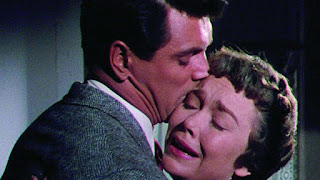
An emotionally bloated romantic melodrama, Magnificent Obsession is a love story inflated by religious pretensions and a close-to-ridiculous narrative.

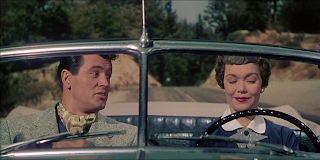
Playboy millionaire and medical school drop-out Bob Merrick (Rock Hudson) crashes his power boat. His life is saved by a resuscitator, but at the same time the respected Dr. Phillips suffers a heart attack and dies because the life-saving device is unavailable. Bob meets the deceased doctor's widow Helen (Jane Wyman) and immediately falls in love with her, but she rejects him as opportunistic and crass.

Helen's friend Randolph (Otto Kruger) mentors Bob about empathy, charitable work, and doing good for others without asking for anything in return. But Bob is clumsy in applying these lessons, and causes an accident that leaves Helen blind and in the care of her loyal nurse Nancy (Agnes Moorehead). Bob adopts the personality of Robby and again tries to prove his love for Helen. He arranges for top medical experts to review her case, but Joyce's step-daughter Joyce (Barbara Rush) remains sceptical.

It's difficult to take anything that happens in Magnificent Obsession seriously. The film is dominated by plastic characters over-emoting at successive contrived crises, and director Douglas Sirk comes dangerously close to delivering an unintended comedy of dreck. The film adapts a 1929 book by Lutheran minister Lloyd C. Douglas, but this is still no excuse for the choral choir to blare onto the soundtrack every ten minutes, triple underlining holier-than-thou awakenings of the spirit.

The love story spends a long time in stalker territory, with stars Rock Hudson and Jane Wyman sharing no chemistry. Sirk does deliver gorgeous aesthetics, sparkling use of colour, and dreamy locations, and the one idyllic evening Bob and Helen spend together in Switzerland finally catches some magic. But then irrational behaviours burst back to prolong the mushiness and trample the mood, the final act striding into plain silly territory.

Rock Hudson is dramatically upright as his character navigates an unlikely arc, but Jane Wyman is mostly bland. Agnes Moorehead and Barbara Rush add quality in the supporting roles. Otto Kruger is saddled with a holiness just short of a visible halo, Sirk even finding a late angle for Randolph to hover over Bob in a physical representation of spectral influence. 

Magnificent Obsession means well, but lacks the sophistication to sell its own beliefs.


All Ace Black Movie Blog reviews are here.

Tuesday, 10 March 2015

Movie Review: Mrs. Parkington (1944)


A sprawling family drama and a grand love story, Mrs. Parkington offers intrigue among the filthy rich and a sweet story of a life-long romance between a simple girl and a swashbuckling entrepreneur.

The Parkingtons are one of New York's richest families. 84 year old matriarch Susie Parkington (Greer Garson) presides over vast wealth, having survived the death of her long-time husband Major Augustus Parkington (Walter Pidgeon). At a Christmas gathering the extended family members reveal themselves to be a fractured, lazy, greedy and back-stabbing bunch. Things are so bad that Susie's great granddaughter Jane (Frances Rafferty) wants to flee the country with fiancĂ© Ned Talbot (Tom Drake), because Ned has uncovered rampant corruption while working as an accountant at the business of Jane's father Amory Stilham (Edward Albert).

While Susie ponders what to do to help Jane and keep Amory out of prison, in flashbacks she recalls her own history and humble beginnings. Born and raised in a small Nevada town, Susie was working at her mother's boarding house when the Major, a flamboyant businessman, rode into town and swept her off her feet. Once in New York, Susie quickly adapted to her husband's upper class social circles with the help of Baroness Aspasia Conti (Agnes Moorehead). Aspasia always loved the Major, but also became close friends with Susie. Through the ups and downs of business cycles, Susie proved herself a worthy partner to the Major, tolerating his wandering eye, defending her marriage, and setting the Major back on the right course when he veered towards cruel and vexatious business practices. Back in the present, Susie has to apply the lessons learned from a lifetime with the Major to sort out her family's latest crisis.

Directed by Tay Garnett, Mrs. Parkington is lavish old-fashioned film-making. This is an enjoyable and memorable romp through the years and within the luxuriously decorated halls of the Parkington mansion. The rags to riches story of Susie's life with the Major serves as an attractive backdrop to the current rich-are-awful narrative. The past and the present come together as Susie draws on a combination of her extraordinary experience, down-to-earth character and the Major's influence to chart a rescue path for her extended family.

Not everything about Mrs. Parkington works quite as well as intended. Garson's make-up at age eighty-four is only partially convincing, and her performance as an old woman is also never quite credible. The film also ekes out a final chapter of the flashback story in England, with Susie traveling to the old country to rescue the Major from the amorous clutches of Alice, Duchess de Brancourt (Gladys Cooper). Susie gets help from none other than the jovial Edward, Prince of Wales (Cecil Kellaway). It's a lively affirmation of Susie's persistence in loving the Major while saving him from his own poor judgement, but the episode arrives quite late in the proceedings and unnecessarily stretches the film to over two hours.

Other scenes work much better, and a particular highlight is an extravagant dinner party that the Major throws to celebrate Susie's first pregnancy. Little goes according to plan, and Garnett creates a tragicomic disaster of a social gathering as the evening unravels, setting the Major off on a vindictive war path.

Greer Garson and Walter Pidgeon add immensely to the appeal of Mrs. Parkington, as their on-screen chemistry again clicks effortlessly. Beyond all the dramas past and present, this is a story of an enduring love and the woman who made it work despite all her husband's foibles. Garson is at her luminous best, a mischievous glint in her eye hinting at how far ahead of the Major she is in thinking about both of their futures. Pidgeon wears the bombastic cloak of the rich and confident, a self-made man who augments his wealth with loads of ego. He gives Susie the nickname Sparrow in honour of a bird he once saved, but she will return the favour and save his soul more than once. Together they make for a most imperfect perfect couple.

In support, Agnes Moorehead delivers a most engaging against-type performance as Aspasia, silent lover of the Major but nevertheless friend to Susie. Peter Lawford, Dan Duryea, and Hugh Marlowe contribute small roles.

Mrs. Parkington is a heartwarming story of one woman's rise to meet life's challenges, good and bad, in the only way she knows how: with honesty, humility, perseverance and a positive spirit.


All Ace Black Blog Movie Reviews are here.


Sunday, 27 April 2014

Movie Review: The Magnificent Ambersons (1942)


The decline and fall of a rich Indianapolis family, The Magnificent Ambersons is a directorial tour-de-force by Orson Welles. Despite significant studio editing, the film sparkles as a gossipy drama and a story of love and jealousy across generations.

Early in the 1900s, the Ambersons are one of the wealthiest families in Indianapolis, and they live in the grandest of mansions. Daughter Isabel (Dolores Costello) rejects the advances of eccentric inventor Eugene Morgan (Joseph Cotten) when he embarasses himself with an awkward fall. She settles instead for the grey Wilbur Minafer (Donald Dillaway). They have a son George, a spoiled brat who grows up to be a conceited young man (Tim Holt).

George returns home from college and immediately sets his sights on Lucy Morgan (Anne Baxter), Eugene's daughter. Eugene is fast becoming a successful tycoon in the nascent automobile industry, while the fortunes of the Ambersons are in a rapid decline due to bad investments. When Wilbur dies, Eugene again tries to ignite a serious romance with Isabel. George strongly objects to his mother having a dalliance with a new man, while Isabel's plain sister Fanny (Agnes Moorehead) is equally devastated, since she had always harboured secret hopes of winning Eugene's affections.

Edited down to just 88 minutes from an eternally lost original cut of 148 minutes, the surviving version of The Magnificent Ambersons is a compact masterpiece of human drama and cinematic wizardry.

Almost every scene in the film is a carefully composed artwork. Welles directs his own script with an emphasis on fluid camera movements, actors seamlessly gliding in and out of the frame, breathtaking long takes, animated backgrounds, and in-scene depth. Shooting through doors, doorways and hallways or in the cavernous rooms of the Amberson mansion (built with moveable walls to accommodate the kinetic camera movements), Welles fills the screen with action behind the action, something always happening in the background to compete with or enhance the foreground main event.

The story is an epic reversal of fortune, fully deserved in the case of George, as his comeuppance unfolds with the full support of a community fed up with his singularly unearned arrogance. The disintegration of the Ambersons is also a classic tale of the ever turning wheel of market forces. George's grandfather Major Amberson (Richard Bennett) loses his touch in picking winning investments just as Eugene Morgan gets to grips with the automobile and steps into the wealthy industrial class through a technology unheard of in the Major's era.

Welles' phenomenal perception is on full display, as even before the private car fully catches on with society, Eugene, in response to a snide comment from George, expresses his concern that his seemingly miraculous invention may yet prove to be a negative societal force.

Eugene: I'm not sure George is wrong about automobiles. With all their speed forward, they may be a step backward in civilization. It may be that they won't add to the beauty of the world or the life of men's souls. I'm not sure. But automobiles have come. And almost all outward things are going to be different because of what they bring. They're going to alter war and they're going to alter peace. And I think men's minds are going to be changed in subtle ways because of automobiles. And it may be that George is right. It may be that in ten or twenty years from now, if we can see the inward change in men by that time, I shouldn't be able to defend the gasoline engine but would have to agree with George: that automobiles had no business to be invented.

The Magnificent Ambersons is also a series of tragic love stories. Eugene and Isabel pursue a love that is simply never meant to be. Small events, the passing years and small people will conspire to keep them apart. Fanny also suffers in solitude, her pathetic pining for Eugene worlds apart from his utter disinterest in her. Even the relationship between George and Lucy stumbles and stalls rather than soars, his haughtiness in contrast to her practical upbringing.

But for all the financial and emotional turmoil, Welles keeps the mood light. The townsfolk provide a prattling commentary on the travails of the Amberson clan, there is a steady diet of humour, and a thread of world-wise resignation accompanies all the heartache.

A grand story which was ultimately destined to be revealed in unusually concise form, the story of the Ambersons remains nevertheless magnificent.


All Ace Black Blog Movie Reviews are here.


Tuesday, 1 October 2013

Movie Review: Citizen Kane (1941)


One of the most outstanding achievements in the history of cinema, Citizen Kane ushered in the era of maverick directors stamping their films with grand personality and vision. Orson Welles assembles a masterpiece of virtuoso storytelling in recounting the amazing tale of a rich industrialist who has everything that can be bought and nothing that matters.

Mega tycoon Charles Foster Kane (Welles) dies a lonely death in his enormous, lavishly furnished but mostly empty Xanadu mansion. His last uttered word is "Rosebud". Journalist Jerry Thompson (William Alland) is tasked with finding out what the word meant, and tracks down Kane's closest associates, including best friend Jedediah Leland (Joseph Cotten) and lifelong employee Mr. Bernstein (Everett Sloane). Through their anecdotes Kane's life story is revealed.

Born to a poor rural family in Colorado, when he was a young boy Kane's mother Mary (Agnes Moorehead) inherited a piece of property where a massive gold deposit was unearthed. Kane's parents place him in the care of banker Walter Thatcher (George Coulouris) and send him away to get an education and see the world until his 25th birthday, when he inherits his massive fortune. Kane never gets over the shock of abrupt separation from his parents and happy childhood.

As a rich young man, Kane has his pick of businesses to run, but decides to personally take control of the New York Inquirer, a struggling newspaper. He uses it as a pulpit to expose corruption, bolstering his popularity and influence, and he goes on to build a massive national media conglomerate. He marries Emily Monroe Norton (Ruth Warrick), the niece of the President, and sets himself up for a career in politics, initially running for the Governor's office.

With Kane riding a wave of popularity and holding a seemingly unassailable lead in the opinion polls, his rival Jim Gettys (Ray Collins) exposes Kane's extramarital affair with lounge singer Susan Alexander (Dorothy Comingore), ending Kane's political career before it starts, and also destroying his marriage. Emily leaves him and he immediately marries Susan. Kane pours enormous resources to try and establish Susan as a serious opera star. As Kane grows ever more obsessed with seeking the world's approval, his remaining personal relationships start to suffer. And still, Thompson doggedly pursues what "Rosebud" could have possibly referred to.

Coming from the world of theatre and radio, Welles was recruited to Hollywood by RKO studios and given complete artistic control. At 24 years old, he set about reinventing the movies, creating his own rules because he did not know that there were any that needed to be followed. The original artistry injected into Citizen Kane is one of the gateways to modern film, a suite of inventiveness that redefined the possible, and recast the role of director as an inspired visionary rather than a studio hack.

Welles sets a challenge for himself by removing all tension about how the movie will end, and establishing his protagonist as not very likable. The film starts at the end, jumps back to the beginning and then moves forward again, as Kane's colleagues recount their memories. That Kane dies a lonely death is not in doubt, and many of the people interviewed by Thompson don't seem all that enamoured by the old man. And so the introduction of the Rosebud puzzle becomes an ingenious plot device, a small word that may help to define a big man, a trivial mystery that propels a grand biography. And among Citizen Kane's ultimate triumphs is the transformation of one of the world's most powerful tycoons into a desperate man deserving of pity.

Welles uses deep focus to fill the screen with layers of activity, all demanding attention. Citizen Kane is filled with shots where the closest item to the screen is driving events in the deep background, and the eye can choose to focus on the catalyst, the reaction, or both.  There are also many scenes of countless people or items filling the screen as far as the eye can see, all in crisp focus, to convey the enormous scale of Kane's empire and influence.

The camera placement is often as important as the unfolding events, Welles providing imposing perspectives, often filming powerful men from below to heighten their high levels of intimidation. When filming large rooms, the cameras capture impressive scope and the majesty of the space, either by demonstrating how full a large hall can be, or by emphasizing size through the cold stillness of under-utilized emptiness. Characters who serve to nudge the story forward but who are not essential to Kane's life are often filmed from the back, or with shadows obscuring their face.

As for the essence of Citizen Kane, Welles and screenwriter Herman J. Mankiewicz were at least partially inspired by the real life story of William Randolph Hearst. The theme of the movie settles on the eternal quest for love and acceptance by a man who has everything except what he needs to close the hole in his heart. Money can buy everything except inner peace, and Kane obsessively attempts to gain the adulation of his newspaper readers, his political supporters and the two women in his life. Often substituting material things for meaningful caring, Kane may have infinite financial resources but limited emotional competence, and money without soul cannot warm the heart. But maybe Rosebud could.

Thompson: Mr. Kane was a man who got everything he wanted and then lost it. Maybe Rosebud was something he couldn't get, or something he lost. Anyway, it wouldn't have explained anything... I don't think any word can explain a man's life. No, I guess Rosebud is just a... piece in a jigsaw puzzle... a missing piece.

Citizen Kane captivates and enthralls, a film as powerful and commanding as Charles Foster Kane himself.


All Ace Black Blog Movie Reviews are here.