Showing posts with label Liza Minnelli. Show all posts

Wednesday, 9 March 2022

Movie Review: New York, New York (1977)

A musical drama and romance, New York, New York is a bloated mess with only a few redeeming moments.

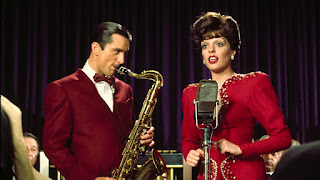
On Victory over Japan (V-J) day in New York City, unemployed saxophone player and serial liar Jimmy Doyle (Robert De Niro) spots United Services Organization (USO) singer Francine Evans (Liza Minnelli) at a celebratory party. He repeatedly pesters her, and she repeatedly rebuffs him. They later meet again in a hotel lobby and he continues stalking her. 

Eventually she accompanies him to an audition, which goes badly until she starts singing. They are hired as a duo act and start a romance, but she soon leaves him and returns to her job as a singer with a touring jazz band. He follows her and lands a job with the band. Jimmy and Francine get married and both their careers experience an upswing, but her pregnancy and his jealousy threaten their happiness.

Fresh from the success of Taxi Driver, director Martin Scorsese intended his next project as an homage to classic Hollywood musicals and a salute to New York City. Unfortunately Scorsese (among others on the project) was battling substance abuse issues, and despite some clever directorial touches and good László Kovács cinematography, New York, New York is a near-disaster and a crushing bore. Improvised dialogue, uninteresting lead characters with no background and no developmental arcs, non-existent secondary characters, poor narrative continuity, and bad editing all extend for an excruciating 163 minutes.

The tone is set in a genuinely awful and endless first scene featuring 35 minutes of repetitive annoyance. Jimmy Doyle is best described as creepy and despicable, and De Niro's performance is proportionately insufferable. A fundamental and painfully obvious problem is a non-script by Mardik Martin and Earl Mac Rauch, which must have been discarded early with the actors asked to just wing it. The outcome is scene after scene of De Niro thinking up ways on the fly to act like a boor, Minnelli visibly flustered or bewildered as her co-star misbehaves and manhandles. 

Scorsese was also having an affair with Minnelli, and therefore she shares no chemistry with De Niro, not that anyone can display any affinity for a character like Doyle. With the romance and narrative elements both in tatters, the music steps in to offer some redemption. The movie's best moments occur when the actors just shut up and the musicians are allowed to play. The final 40 minutes mercifully dispose of any narrative pretensions and simply focus on a series of Minnelli concert performances, culminating in her spirited rendition of the title song, written for the movie by John Kander and Fred Ebb. 

Ironically, New York, New York cannot make it there, and cannot make it anywhere.


All Ace Black Movie Blog reviews are here.

Wednesday, 1 June 2016

Movie Review: Cabaret (1972)


A brilliantly decadent musical, Cabaret is set in Berlin of the early 1930s. The rise of the Nazi party creates a strong undercurrent of menace shaping the adventures of a brash entertainer and a reserved English teacher as they pursue their dreams.

It's 1931, and Englishman Brian Roberts (Michael York) arrives in Berlin to make some money as an English language teacher for adults. At his rooming house he meets the flamboyant and talkative Sally Bowles (Liza Minnelli), a performer at the Kit Kat Klub, a hot nightspot presided over by a Machiavellian master of ceremonies (Joel Grey). Sally owns little other than dreams of becoming a famous actress, and she has no hesitation to use her sexuality to get what she thinks she wants from men. She helps find clients for Brian, and they become friends.

Brian's students soon include struggling businessman Fritz (Fritz Wepper) and beautiful rich heiress Natalia (Marisa Berenson), a member of a prominent Jewish family. Fritz starts a hot pursuit of Natalia, but her religion as well as the wealth gulf are a hindrance. Meanwhile Sally meets the very rich and attractive Maximilian von Heune (Helmut Griem), and he puts a wrinkle in the burgeoning relationship between Sally and Brian. With the Nazis gaining in dangerous influence on the streets of Berlin, the performances at the Kit Kat Klub echo the changing political landscape and prevailing economic struggles.

Directed by Bob Fosse, Cabaret is a masterpiece musical, and a classic piece of subversive cinema. The adaptation and amalgamation of several previous books and stage productions weaves politics, liberated sexuality, depravity, and economic desperation into one story propelled by cabaret music performances, and it all works brilliantly. The musical numbers are satirically sharp, the struggles of Sally and Brian depressingly real, and the creeping menace of extremism morphing into the mainstream takes place with the insidious slitheriness of a snake.

Much like an entire society slipping into the grips of a fascist dictatorship, the story of Sally Bowles is one of comprehensive self-delusion. She convinces herself that her missing father is an important man who cares about her. She dreams of becoming a movie star but does little to make it happen, and spends her time seducing men with her wild stories and expansive mannerisms, unaware that she is the one being used and discarded. Yet Sally survives thanks to her cluelessness, and she is happy in her state of manufactured sophistication.

More astute but equally misguided is Maximilian, who assures Brian that the Nazis are useful thugs who will rid Germany of communists but can themselves be easily controlled. Meanwhile Fritz and Natalia represents the breadth of German society from poor businessman to wealthy heiress. That she is Jewish already represents a problem. As a potential couple, their future under the gathering dark clouds of intolerance is beyond bleak.

Except for one, all the musical numbers take place on the Kit Kat Klub stage, and provide a running commentary on the unfolding personal and public dramas. Money Money reflects the obsession with scraping a living; Two Ladies celebrates threesomes; If You Could See Her announces the full-fledged arrival of anti-semitism at its most hideous. Maybe This Time is the one Sally Bowles personal performance and is delivered to an empty club: her forlorn hope for personal happiness doesn't draw an audience.

The one song delivered outside the cabaret is the most fearsome. Tomorrow Belongs To Me is sung by a handsome Hitler youth member at a suburban park, sparking Germans of all ages to stand up and sing along with blind passion, heralding the rise of the Nazi party from sideshow to centrepiece. Just the one old timer refuses to join in; he clearly remembers previous horrors about to be repeated.

In a chequered movie career, Sally Bowles was the one perfect role for Liza Minnelli. Larger than life, loud, seductive and operating on the fumes of borrowed cigarettes, bad alcohol and a life wasting away on a small stage, Minnelli is unforgettable. Her boundless energy drives the film forward at the club and away from it, with a few rare but key introspective interludes where she admits that all is not well. Joel Grey as the nameless master of ceremonies is the other memorable presence. With no lines of dialogue but plenty to say, he is a clownish presence with a dark interior, the late night host of his era, providing commentary that serves as both sophisticated entertainment and unfettered warning.

Cabaret was rewarded with eight Academy Awards including statues for Fosse, Minnelli, Grey (Supporting Actor), and Geoffrey Unsworth (Cinematography). It's the most decorated film that wasn't also crowned Best Picture (it was also the year of The Godfather).

Cabaret ends as it starts with an image in a warped mirror. But while the opening finds the master of ceremonies about to reflect back a devious view of society onto his stage, the ending is much more ominous. The danger has moved from the outside to the inside, and now occupies a prime seat at the table. The fun and games at the Kit Kat Klub are about to be replaced by a descent into the worst kind of evil, dragging the world into the abyss.


All Ace Black Blog Movie Reviews are here.

Saturday, 16 July 2011

Movie Review: Arthur (1981)


A perpetually drunk ultra rich playboy who never grew up has to decide, through the fog of alcohol, whether to follow love or money. Arthur is funny and poignant, with memorable performances by Dudley Moore and John Gielgud, and it makes no apologies for a central message promoting drunken oblivion as an alternative that is just a bit better than stuffy conformity.

New York-based playboy Arthur Bach (Moore) has all the money in the world, but his only friend is his butler Hobson (Gielgud). Arthur squanders his time on continuous drinking and picking up prostitutes, as he escapes from the inevitable demands of his family: his father and grandmother insist that he marry the sweet, rich but uninteresting Susan (Jill Eikenberry), otherwise they will cut him off from his fortune.

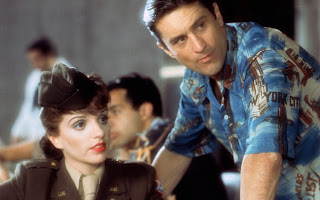
While shopping for clothes at a ritzy store, Arthur notices a shoplifter: Linda Marolla (Liza Minnelli) is a poor waitress who lives with her Dad, and Arthur is immediately attracted to her, saving her from being prosecuted. Arthur's marriage plans to Susan are proceeding as he is falling in love with Linda, while Hobson is serving his master while battling an increasingly serious illness. Choosing Linda over Susan means that Arthur will alienate his family and be forever poor, but with alcohol fuelling his decision making, everything will surely work out.

Dudley Moore had a few good years of stardom in the late 1970s and early 1980s, and Arthur was his defining role, and certainly his most celebrated. He goes though most of the movie acting intoxicated, speech slurred, walk askew, laughing hysterically and spewing jokes that are funny only to him. Arthur is an endearing character in a way that a helpless, lost pet evokes sympathy, and it is to Moore's credit that both Susan and Linda's attraction to Arthur is believable.

John Gielgud, at 77 years old, won the Academy Award for Best Supporting Actor for his portrayal of Hobson, the butler who is quite certain that he in fact runs the life of his master. As stiff and proper as Arthur is lubricated, the prickly friendship between Arthur and Hobson is at the core of the film. That Hobson is the only person in the world that Arthur can communicate with summarizes Arthur's sad state, and as illness takes Hobson away, it is only natural that Arthur is attracted to the down-to-earth Linda (a waitress) to fill the vacuum.

Liza Minnelli as Linda gets somewhat lost in the acting shuffle, unable to move too far away from just being a slightly subdued Liza Minnelli.

Arthur contributed a terrific song to the cultural landscape, Arthur's Theme (Best That You Can Do) by Christopher Cross easily entering the hall of classic movie contributions to music, with it's catch line "when you get caught between the Moon and New York City" perfectly capturing Arthur's dilemma.

Arthur may not be a practically helpful guide for how to go about achieving success in life, but if being in the company of a drunk is necessary, he may as well be lovable.


All Ace Black Blog Movie Reviews are here.